Signs Your Fine Wine Portfolio Is Overexposed
A fine wine portfolio can contain dozens of different wines and still be heavily concentrated.
That is because diversification is not measured by counting labels.
An investor might own wines from ten producers, across several vintages, and assume the portfolio is diversified. Yet if most of those holdings are Burgundy, depend on the same buyer demand and would need to be sold into the same section of the secondary market, the underlying exposure may be much greater than it first appears.
This becomes increasingly important as the value of a portfolio grows.
At €100,000, €250,000 or more, concentration is no longer simply about whether you own enough different wines.
The more important question is:
How much of your portfolio depends on the same thing continuing to go right?
That is where a meaningful assessment of fine wine portfolio exposure should begin.

What Does Overexposure Mean in Fine Wine Investment?
Portfolio overexposure occurs when a disproportionate amount of capital, risk or expected future value is dependent on one particular part of the market.
That could mean excessive exposure to:
One region
One producer
One vintage
One appellation
One price segment
One investment thesis
One type of buyer
One liquidity profile
The important distinction is between concentration that is intentional and concentration that has simply developed over time.
There is nothing inherently wrong with deliberately holding a significant position in an area where you have strong conviction.
The risk appears when the investor does not realise how dependent the portfolio has become on that position.
The broad fine wine market itself is made up of materially different regional segments.
The Liv ex Fine Wine 1000, for example, separates the market into Bordeaux 500, Bordeaux Legends 40, Burgundy 150, Champagne 50, Rhône 100, Italy 100 and Rest of the World 60. Those components do not move identically, which is one reason regional exposure matters when assessing portfolio construction.
1. One Region Dominates Your Portfolio Value
The clearest warning sign is excessive regional concentration.
Consider an investor holding:
Bordeaux
Burgundy
Champagne
Piedmont
Tuscany
On the surface, this appears diversified.
But suppose Burgundy accounts for 60 per cent of the total portfolio value.
The investor does not really have a broadly diversified regional portfolio. They have a Burgundy led portfolio with smaller allocations elsewhere.
This matters because different fine wine regions have different characteristics.
Bordeaux tends to offer greater market depth across a large number of established producers. Burgundy combines exceptional scarcity with much smaller production. Champagne has different consumption dynamics. Piedmont and Tuscany introduce exposure to another geography, producer base and buyer market.
Recent Liv ex data illustrates why the distinction matters. Its broad Fine Wine 1000 and regional indices have produced materially different results across Bordeaux, Burgundy, Champagne, Rhône and Italy over the same periods.
Ask:
What percentage of portfolio value sits in each region?
Has that percentage changed significantly since the portfolio was constructed?
Was the current allocation deliberate?
Would I choose the same regional weighting if building the portfolio today?
The fourth question is often the most revealing.
2. You Own Different Wines From the Same Producer
Producer concentration can be surprisingly easy to overlook.
Imagine owning six vintages from the same domaine.
They are six different wines from an inventory perspective.
From a portfolio risk perspective, however, they may share many of the same
characteristics.
Their future demand may depend on:
The producer's reputation
Collector sentiment
Critical reassessment
Regional demand
Availability
The same international buyer base
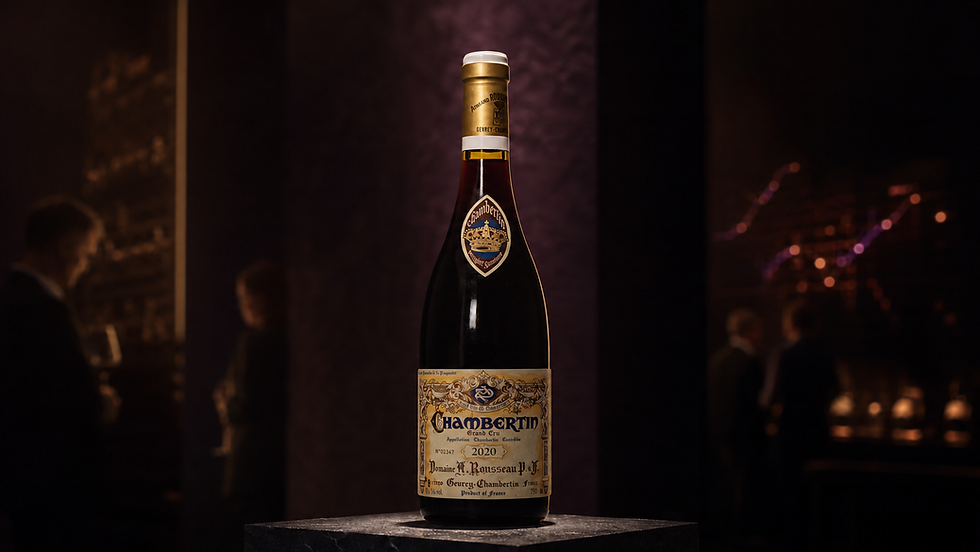
This becomes particularly important with highly valuable producers such as Domaine de la Romanée Conti, Domaine Armand Rousseau, Château Lafite Rothschild, Château Margaux or Château Mouton Rothschild.
These are globally recognised names, but recognition does not remove concentration risk.
Even exceptional assets can become too large a proportion of a portfolio.
Calculate producer exposure by value
Do not simply count cases.
A single case of an extremely valuable Burgundy could represent more capital than numerous cases elsewhere in the portfolio.
Calculate:
Value of producer holdings ÷ total portfolio value × 100
That gives you the actual producer exposure.
3. Portfolio Growth Has Created Concentration Without You Buying Anything
Overexposure does not always result from buying too much.
Sometimes success creates it.
Suppose an investor originally constructs a €200,000 portfolio with:
€60,000 Burgundy
€60,000 Bordeaux
€30,000 Champagne
€30,000 Piedmont
€20,000 Tuscany
That is a deliberately constructed allocation.
Now imagine Burgundy materially outperforms the other positions.
Without buying another bottle, Burgundy could eventually represent a much larger proportion of total portfolio value.
Your allocation has changed even though your purchasing behaviour has not.
This is why portfolio diversification needs reviewing over time.
The portfolio you built is not necessarily the portfolio you own today.
4. Too Much Capital Is Tied to the Same Vintage
Vintage concentration is another risk that can hide behind apparently diverse holdings.
You may own:
Château Margaux
Château Lafite Rothschild
Château Haut Brion
Château Mouton Rothschild
Five producers.
But if every holding comes from the same Bordeaux vintage, the portfolio contains a shared exposure.
Vintage concentration can matter because market perceptions, release pricing, critic assessments, maturity and buyer appetite can affect multiple wines from the same year.
Review your portfolio by:
Region
Producer
Vintage
Value
Looking at only one of these dimensions gives an incomplete picture.
5. Your Portfolio Depends Too Heavily on One Investment Thesis
This is where portfolio analysis becomes more sophisticated.
Two holdings do not need to share a region or producer to share the same risk.
Perhaps several positions were purchased because you expect increasing Asian demand.
Perhaps multiple wines depend on ultra scarce production supporting higher prices.
Perhaps much of the portfolio is positioned around younger wines appreciating as they approach maturity.
Perhaps several acquisitions depend on demand continuing to expand at the highest end of the market.
Different labels.
Same underlying assumption.
Ask:
What has to happen for this investment to perform as expected?
Then ask the same question for every major holding.
If the answers are repeatedly similar, your portfolio may contain hidden concentration.
6. You Have Diversified by Bottle Count Rather Than Capital
Ten different wines do not create ten equal positions.
Consider a €250,000 portfolio containing 20 different holdings.
That sounds diversified.
But if three holdings represent €150,000 of its value, 60 per cent of the portfolio is concentrated in just three positions.
This is why sophisticated portfolio analysis should look at capital weighting, not just
inventory.
For every significant position, calculate:
Percentage of total acquisition cost
Percentage of current portfolio value
Percentage of expected future exit value
The results can look very different.
7. Too Much of the Portfolio Has the Same Liquidity Profile
Diversification is not only about what you own.
It is also about whether you can sell it.
The Liv ex Fine Wine 100 focuses on sought after wines with strong secondary markets, while its pricing methodology uses actual trading information, bids and offers. This highlights an important distinction between theoretical value and market liquidity.
A portfolio can contain exceptional wines yet still be exposed if too much capital sits in positions with:
Limited trading frequency
Wide bid and offer spreads
Few active buyers
Very high individual case values
Narrow geographical demand
Limited recent transaction evidence
This creates liquidity concentration.
If you needed to release 20 per cent of the portfolio's value, which wines could realistically provide it?
If the answer depends on one or two positions, that deserves attention.
8. Your Portfolio Is Heavily Weighted Towards Prestige
There can be a natural tendency for established investors to move progressively
towards rarer and more prestigious wines.
This makes intuitive sense.
As capital increases, access improves and increasingly scarce opportunities become available.
But prestige and portfolio quality are not automatically the same thing.
An allocation heavily concentrated in trophy wines can introduce:
Higher individual position values
Narrower buyer pools
Greater sensitivity to collector sentiment
Potentially longer exit periods
A €20,000 position and ten €2,000 positions create very different portfolios, even if their total value is identical.
The question is not whether the prestigious wine is desirable.
It is whether its weighting is appropriate.
9. You Keep Adding to What Has Already Performed Well
One of the easiest ways to create concentration is repeatedly adding to the area of the portfolio that has already produced the strongest results.
Success creates confidence.
Confidence encourages greater allocation.
Greater allocation creates concentration.
This can happen with:
Burgundy after strong appreciation
A particular Bordeaux château
Champagne
A successful producer
A specific investment strategy
The danger is assuming that past performance validates an increasingly large future allocation.
A useful question is:
Am I buying this because it improves the portfolio, or because previous purchases worked?
Those are not the same thing.
10. New Purchases Look Increasingly Similar to Existing Holdings
Before acquiring another wine, consider what it actually adds.
Not simply:
Is this a good wine?
Instead:
What does this add to my portfolio that I do not already have?
A new acquisition could add:
Different regional exposure
Greater liquidity
Scarcity
A different maturity profile
Another price point
Different buyer demand
Greater portfolio resilience
If every new purchase strengthens an exposure, you already have, the portfolio can become increasingly concentrated while appearing more diversified because the number of holdings keeps growing.
11. A Single Market Movement Could Affect Too Much of the Portfolio
A useful stress test is to imagine adverse scenarios.
What happens if:
Burgundy demand weakens?
Bordeaux liquidity contracts?
Champagne prices correct?
Asian demand for a particular producer declines?
A major position becomes difficult to sell?
One vintage falls out of favour?
Demand shifts towards different price points?
You do not need to predict whether any of these events will happen.
The purpose is to understand the consequences if they do.
If one plausible change would materially affect a large percentage of your portfolio, you have identified a concentration risk.
12. Your Portfolio Has No Obvious Source of Rebalancing Capital
Diversification and liquidity are closely connected.
Imagine recognising that Burgundy now represents too much of your portfolio.
What happens next?
Can you:
Redirect future allocations elsewhere?
Reduce exposure without accepting an unattractive price?
Rebalance gradually?
Use maturing holdings to fund new allocations?
An overexposed portfolio with strong liquidity provides options.
An overexposed portfolio with weak liquidity can leave the investor trapped between
accepting the concentration and accepting an unattractive exit.
This is why liquidity should form part of portfolio construction from the beginning rather than being considered only when the investor wants to sell.
How to Check Whether Your Fine Wine Portfolio Is Overexposed
A practical review should examine the portfolio from several angles.
Step 1: Calculate regional exposure
Determine what percentage of current portfolio value sits in:
Bordeaux
Burgundy
Champagne
Piedmont
Tuscany
Rhône
Napa Valley
Other regions
Step 2: Calculate producer exposure
Identify the five largest producer positions by current value.
Step 3: Calculate vintage exposure
Look for years that represent a disproportionate share of the portfolio.
Step 4: Assess liquidity
Separate holdings into broadly:
High liquidity
Moderate liquidity
Lower liquidity
The classification should be based on credible secondary market evidence rather than reputation alone.
Step 5: Identify shared investment assumptions
Ask what conditions each major position depends upon.
Step 6: Stress test the portfolio
Consider what happens if one region, producer or segment experiences weaker demand.
Step 7: Review exit options
Determine where future liquidity would realistically come from.
The purpose is not to produce a perfect mathematical allocation.
It is to expose dependencies that may otherwise remain invisible.
Does Overexposure Mean You Should Sell?
Not necessarily.
Identifying concentration does not automatically mean correcting it immediately.
There may be sound reasons for maintaining an intentionally concentrated position.
The decision depends on:
Your investment objectives
Acquisition price
Holding period
Liquidity
Transaction costs
Conviction
Wider wealth allocation
There are also several ways to reduce concentration without immediately selling existing holdings.
You might:
Direct future capital towards underrepresented areas.
Stop adding to the concentrated position.
Allow other parts of the portfolio to grow around it.
Rebalance gradually as liquidity opportunities arise.
Sell selectively rather than exiting an entire position.
The objective is not to make every category equal.
It is to ensure every concentration is understood and intentional.
Diversification Does Not Mean Owning Everything
A well-diversified fine wine portfolio does not need exposure to every region.
Nor should an investor buy a weaker asset purely to make a spreadsheet look balanced.
Diversification only creates value when the underlying holdings remain investment worthy.
The aim is therefore not maximum diversification.
It is purposeful diversification.
That means balancing considerations such as:
Quality
Scarcity
Provenance
Liquidity
Producer strength
Regional exposure
Vintage exposure
Buyer demand
Holding period
Exit options
This is particularly important because the fine wine market is not homogeneous.
Current Liv ex market reporting continues to show different trading patterns across Bordeaux, Burgundy, Champagne and Italian regions, with buyer activity concentrating selectively rather than moving uniformly across the entire market.
Overexposure in a €100,000+ Fine Wine Portfolio
As the amount invested increases, portfolio structure becomes increasingly important.
A €100,000+ investor should be able to answer:
What percentage of my portfolio sits in each region?
What are my five largest individual positions?
Which producers represent the greatest capital exposure?
Which vintages dominate?
What percentage of my portfolio has strong secondary market liquidity?
Which holdings depend on similar market conditions?
Which positions have become larger because of appreciation?
Where is the portfolio genuinely diversified?
Where does it only appear diversified?
If these questions are difficult to answer, the problem may not necessarily be overexposure.
The immediate problem is that you do not yet know whether you are overexposed.
The Difference Between Conviction and Concentration
There is an important distinction between deliberately taking a meaningful position and accidentally becoming dependent on it.
Sophisticated investors do not necessarily avoid concentration.
They understand it.
They know:
Where it exists
Why it exists
How much capital it represents
What could affect it
How liquid it is
What would trigger a reassessment
How they could reduce it if necessary
That turns concentration from an unnoticed vulnerability into a deliberate portfolio decision.
The Question Every Fine Wine Investor Should Ask
When reviewing an established portfolio, ask:
If my largest exposure performed poorly for the next five years, would I still be
comfortable with the structure of my portfolio?
If the answer is no, the issue deserves closer examination.
Fine wine portfolio diversification is not about predicting which region, producer or vintage performs next.
It is about constructing a portfolio that does not require one prediction to be right.
Review Your Portfolio Exposure With Lafleur Wine Investment
Lafleur Wine Investment works with private investors who already own fine wine and want to understand how effectively their holdings work together as a portfolio.
For investors with €100,000 or more allocated to fine wine, we can look beyond individual bottles and consider the wider structure, including regional allocation, producer concentration, vintage exposure, liquidity, provenance, risk and future exit options.
The objective is not to change a portfolio simply for the sake of activity.
It is to understand where your capital is concentrated, whether that concentration remains appropriate and what role each holding should play within your long-term strategy.
Arrange a private conversation with Marc about your existing fine wine portfolio.