How to Build the Perfect Wine Investment Portfolio
Updated: 5 days ago
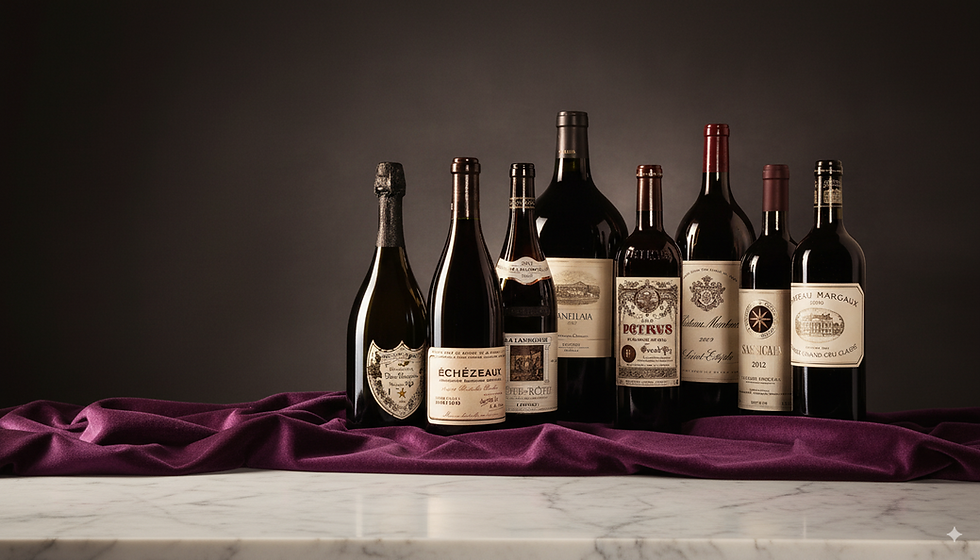
Building the perfect wine investment portfolio may naturally include some of the most celebrated names in the market, yet the real discipline lies in understanding why each wine deserves its place, whether it is selected for enjoyment, performance, liquidity, scarcity or long-term legacy. A repeatedly 100-point Château Latour, a scarce Burgundy Grand Cru and a mature Rhône legend may all belong in the same portfolio, but not for the same reasons and not with the same expectations. This article explores how serious investors can think more clearly about wine selection, using concrete examples from Bordeaux, Burgundy and the Rhône to distinguish between wines that preserve value, wines that may drive stronger returns, and wines that carry deeper cultural or generational significance.

Every Wine Needs a Reason to Be There
The perfect wine investment portfolio should begin with a critical question: what do you actually want the wines to do for you, financially, emotionally, and strategically? That question sounds simple, but it is where many portfolios start on the wrong foot. A collector may want pleasure, status, liquidity, capital preservation, long-term appreciation, cultural depth, and perhaps a few cases to open with family in twenty years. None of these objectives is wrong. The problem starts when they are confused with one another.
And to add to the confusion wine has this unusual ability to blur categories. A bottle can be emotionally irresistible, historically meaningful, financially credible and culturally symbolic at the same time. That is precisely what makes fine wine such a fascinating asset. It is also what makes portfolio construction more complex than a spreadsheet suggests.
Most investors understand the basic theory. Investment-grade wine represents only a fraction of global production. The best wines benefit from limited supply, growing demand, improving quality, critical recognition, brand prestige and, over time, natural depletion as bottles are consumed. But within that small investment-grade universe, performance can diverge dramatically. Two wines may look equally impressive on paper, share high scores, global recognition and long ageing potential, yet behave very differently over twenty years.
How to build the perfect wine investment portfolio is therefore not a matter of simply buying the most celebrated labels. It is about understanding the role each wine plays inside the broader strategy, and being clear-eyed about why it deserves its place.
Selection Is Not as Obvious as It Looks
The first temptation is to believe that reputation alone is enough. Buy the famous producer, buy the strong vintage, buy the high score, wait patiently. Sometimes it works beautifully. Sometimes it does not.
Take Guigal’s Côte-Rôtie La Turque 2005. Guigal is one of the great names of the Rhône, with extraordinary global reach. Its wines are represented across almost every serious market, from the accessible Côte du Rhône to the legendary Côte-Rôtie trio La Mouline, La Turque and La Landonne. These are benchmark wines, repeatedly celebrated by critics, with La Turque 2005 receiving perfect scores from both Robert Parker and Jeb Dunnuck.
And yet, after nearly twenty years on the market, La Turque 2005 has delivered a modest gain of around 19% according to Liv-ex data. This is not the sort of number investors dream about when they hear the words “investment-grade wine”. In purely financial terms, it raises a fair question: does this wine belong in an investment portfolio at all?
My answer would be yes, but not for the wrong reason. La Turque may not be the highest performer in the fine wine universe, but it remains a magnificent wine, with strong liquidity, exceptional quality, global recognition and real cultural standing. The issue is not whether it is “good enough”. The issue is expectation. If one buys Guigal La Turque expecting Burgundy-like scarcity dynamics and double-digit annual growth, disappointment may follow. If one buys it as a liquid, age-worthy, emotionally rewarding wine that can preserve value while offering profound future drinking pleasure, the decision becomes far more rational.
That distinction is central to portfolio construction. At Lafleur Wines, we often think in terms of three broad pillars: enjoyment wines, high performers, and legacy or icon wines. These categories are not rigid. The strongest bottles often sit at the intersection of all three. But the distinctions help create clarity. They prevent a portfolio from becoming an expensive accumulation of beautiful labels with no internal logic.
The First Pillar: Enjoyment Wines
Enjoyment wines are often misunderstood. They are not casual drinking bottles, and they are certainly not an excuse to confuse personal affection with investment discipline. They may bring pleasure, but in a wine investment portfolio, they must still carry market credibility. The charming Gigondas discovered on holiday, or the artisanal Sangiovese enjoyed in a family-run restaurant somewhere in the Tuscan countryside, may have created a beautiful memory. Such bottles may deserve a place in your private cellar. But if they lack international recognition, secondary market depth and a broad enough buyer base, they do not belong in an investment portfolio.
Enjoyment wines, in this context, must still be tradeable. They must preserve value, remain visible to the market, and carry enough brand power, critic recognition and liquidity to justify their place. The difference is that their primary role is not necessarily maximum financial appreciation. Their role is to offer pleasure, optionality and emotional comfort within the portfolio.
Which brings us back to Guigal’s La Turque. The 2019 vintage has received extraordinary critical recognition, with scores clustered in the high 98–100 range. The wine is built for long ageing, potentially through 2050. It promises to deliver immense pleasure from around 2035 onwards, assuming proper storage. It has enough global recognition to remain liquid. It may not be the most aggressive performance engine in the portfolio, but it can still contribute meaningfully.
This is where investor psychology becomes important. Performance is rarely the only thing an investor expects from a wine portfolio, even when capital appreciation is the primary objective. Some wines are selected because they concentrate scarcity and upside potential. Others are included because they offer liquidity, drinking pleasure, recognisable prestige, or the reassurance that part of the portfolio can be enjoyed without compromising the broader strategy. This does not make them lesser wines. It simply means they serve a different purpose. A great Burgundy may carry immense emotional intensity and still be primarily selected as a high-performance asset, while a wine such as La Turque may justify its place through a different combination of pleasure, reputation, longevity and value preservation.
There is nothing unprofessional about that. Quite the opposite. The key is to price that emotion honestly. Pleasure should have a place in the portfolio, but it should not be allowed to disguise itself as performance.
The Second Pillar: High Performers
If enjoyment wines bring emotional depth and liquidity, high performers bring the sharper edge of portfolio construction. This is where scarcity matters most, although the word itself needs to be handled carefully. Fine wine is full of scarcity narratives, and not all of them deserve to be taken at face value.
For decades, Bordeaux First Growths have been described as rare wines. They are rare in a cultural sense, and their historical importance is beyond dispute. But from a production standpoint, the picture is different. The five First Growths together produce roughly one million bottles per year. That does not make them ordinary wines, of course, but it does place them in a very different category from the upper levels of Burgundy, where production can fall into the low thousands, or even hundreds, of bottles per vintage.
This is why Burgundy has become so central to fine wine performance. At the top end, Burgundy sits at the intersection of artisanal production, limited vineyard surface, global desirability and extraordinary collector psychology. Many leading producers may release village wines in meaningful quantities, but their premier cru and grand cru bottlings are often produced in only 1,000 to 5,000 bottles per vintage.
In some cases, the numbers are microscopic. Claude Dugat’s Griotte-Chambertin Grand Cru comes from a tiny 0.15-hectare plot, with production often around 600 to 800 bottles depending on the vintage. Robert Groffier’s Chambertin can come from a single barrel, roughly 350 bottles. Such figures immediately awaken the investor imagination, but they also require nuance.
Extreme rarity can undermine liquidity. A wine may be so scarce that it becomes almost invisible to the broader market. For investment purposes, there is often an ideal zone: rare enough to be difficult to access, but visible enough to sustain global desirability. Many of the strongest performers sit somewhere in the 1,000 to 5,000 bottle bracket.
This is where the arithmetic becomes powerful. Production is fixed. Bottles are consumed. Mature stock becomes harder to find. The best vintages gain critical and emotional authority. Collectors who missed the wine at release become more willing to pay a premium later. If the producer’s reputation continues to strengthen, the imbalance becomes even more acute.
Georges Roumier Bonnes Mares is a benchmark example. The domaine has deep brand power, its Bonnes Mares has international recognition, and production of roughly 3,500 bottles per vintage seems to sit near that ideal balance between visibility and scarcity. Over a 15-year holding period, this is a wine that can move into the realm of potential double-digit annualized returns, provided entry price, vintage selection, provenance and storage are correctly managed.
Keeping the 15-year horizon in mind is essential, because even high performers require patience. Fine wine returns do not materialize on a quarterly basis. They tend to appear when the market discovers that your full case of six bottles of Sylvain Cathiard’s Romanée-Saint-Vivant is one of the very few pristine options still available. The objective is therefore not to chase short-term price movements, but to acquire full cases of genuinely scarce wines, with impeccable provenance, and hold them until comparable stock becomes increasingly difficult to source. In fine wine, time does part of the work. But only if the initial selection was disciplined. The scale of this performance dispersion can be seen in Lafleur’s historical wine performance data, comparing selected wines and regional portfolios over five, ten and fifteen years.
Where Bordeaux Really Belongs in a Wine Investment Portfolio
This raises an interesting question. Where do the great Bordeaux First Growths sit in a wine investment portfolio? Many investors instinctively place them in the high-performance category. In reality, I would often place them closer to enjoyment wines, at least over the medium term. Their quality is extraordinary. Their liquidity is exceptional. Their brand power is unmatched. But their production volumes are significant, and their price performance can be surprisingly uneven. Bordeaux is not weak as an investment category, but it does not always behave according to the assumptions investors bring to it.
Mouton Rothschild 2009 is a prime example. It comes from a legendary vintage, carries an aura of prestige few wines can match, and has been described in glowing terms by some of the most influential critics, including Antonio Galloni, who praised its “exceptional beauty”. Yet its market performance has been heavily affected by its original En Primeur release price, which was disconnected from consumers’ perception of value at the time. After gradually moving back towards its release level during the 2020–2022 fine wine bull market, the wine has since fallen again. In May 2026, Liv-ex reported a negative performance of around 38% for Mouton Rothschild 2009, a reminder that pedigree, vintage reputation and critical acclaim do not automatically translate into attractive entry economics.
Does this mean Bordeaux should be dismissed? Absolutely not. It means the time horizon must be understood correctly. Bordeaux does not always behave like Burgundy. The great First Growths may require generational patience. If top Burgundy can become almost impossible to find after 10 to 20 years, the equivalent effect in Bordeaux may take 40 to 60 years.
The good news is the very best Bordeaux are built for exactly that time horizon. They can travel across a far portion of a century, holding not only financial value but extraordinary drinking potential. This is where the mistake often occurs. Investors judge Bordeaux over the wrong interval, then conclude that it has failed. In reality, they may simply be measuring a cathedral with a wristwatch.
Mouton Rothschild 1945 is the obvious reference point. Its significance goes far beyond wine quality. The vintage coincided with the end of the Second World War, and Philippe Jullian’s “V for Victory” label gave it cultural weight that no marketing campaign could ever recreate. Bottles have achieved extraordinary prices at auction, including around USD 34,000 per bottle in 2016. Yet the wine is not merely symbolic. Neal Martin has awarded it perfect 100p scores in recent tastings and suggested it could age beautifully into the 2040s.
Bordeaux performance can be profound, but the greatest results often belong to those willing to think beyond their own immediate consumption horizon. In a portfolio, the First Growths can bring liquidity, gravitas, pleasure and historical depth, making them natural crowns within the enjoyment pillar. But if the objective is performance, the investor needs a different lens: greater selectivity, greater patience, and a willingness to think in generational terms rather than medium-term market cycles.
The Third Pillar: Legacy and Icons
Legacy wines are where the Bordeaux argument becomes much clearer. The strength of a First Growth lies in its capacity to age for most of a century, to remain globally recognizable, to preserve liquidity across generations, and eventually to become a historical reference rather than simply a current market listing.
This is why Bordeaux performance should sometimes be read on a longer scale. In the early years, availability may remain high and price movement may look uninspiring, especially when release pricing was ambitious. Over time, however, the equation slowly changes. Bottles are consumed, original cases disappear, pristine provenance becomes harder to find, and the greatest vintages begin to detach themselves from the ordinary rhythm of the market.
Seen this way, the question is no longer whether Bordeaux has “performed” after ten or fifteen years. The better question is whether a particular wine has the quality, longevity, brand power and cultural significance to become one of the reference bottles of its generation. That is a very different investment logic, and it is precisely why the legacy category deserves its own place in the portfolio.
Château Latour 2010 is a strong candidate. It has received multiple perfect scores and has been called “The King” by Neal Martin. Jeb Dunnuck has suggested it may age until 2100. Despite this, its price has not moved dramatically since release, and availability remains reasonable for now. That combination is unusual: extreme quality, extraordinary longevity, global brand power and a market price that has not yet fully expressed the wine’s long-term symbolic potential.
Mouton Rothschild 2016 belongs in the same conversation. Another multiple 100-point wine, with close to a century of ageing potential, it offers the kind of narrative that serious collectors understand instinctively. One can imagine a future generation opening a bottle and realizing that it was acquired decades earlier with that precise moment in mind.
This is not sentimental decoration. It is part of what makes wine different from most assets. A share certificate does not gather emotional meaning in the same way. A bond does not mature into a sensory experience. A wine such as Latour 2010 or Mouton 2016 can become both an asset and a family memory waiting to happen. That is why the legacy category deserves its own place. It reminds us that the perfect wine investment portfolio is not only a financial construction. It is also a statement about time, taste, patience and continuity.
Balance, Not Formula
You may be disappointed that I am not delivering an off-the-shelf recipe, but there is no universal formula for the perfect wine investment portfolio. A performance-driven investor may allocate heavily toward scarce Burgundy and selected rising stars. A more pleasure-oriented collector may want a stronger base of Bordeaux, Rhône, Champagne and Italian icons. A family office thinking across generations may place greater emphasis on legacy wines with proven longevity and cultural permanence.
The mistake is to pretend that all investors should hold the same portfolio. Fine wine portfolio allocation matters. Time horizon matters. Liquidity expectations matter. Personal connection matters. So does temperament. Some investors are comfortable with Burgundy’s intensity and volatility. Others prefer Bordeaux’s depth, liquidity and long historical frame. Some want to own wines they may one day drink. Others are happy never to touch the bottles, provided provenance, storage and exit routes are professionally maintained.
How to build the perfect wine investment portfolio therefore comes down to alignment. The wines should reflect your objectives, the categories should reflect your mindset, and the holding period should respect the nature of the wines themselves. Storage needs to support future resale, while acquisition prices need to be grounded in market reality rather than emotion dressed up as conviction.
A well-built portfolio is not the one that looks most impressive on a list. It is the one where every wine has a reason to be there. Some wines protect value. Some create optionality. Some carry performance potential. Some preserve a piece of culture. The discipline lies in knowing the difference before capital is deployed.
The Adviser’s Role
The fine wine market is no longer opaque in the way it once was. Data has improved. Pricing platforms, trade records and critic databases have made the market easier to read. But more information does not automatically create better decisions. In many cases, it simply gives investors more ways to confirm what they already wanted to believe.
The real work lies in interpretation. Why has one perfect-score wine underperformed while another has compounded beautifully? Is a famous producer temporarily mispriced, or structurally overvalued? Is a tiny-production wine genuinely desirable, or merely obscure? Is a Bordeaux vintage ready for acquisition, or still burdened by its release price? Is a Burgundy correction a warning sign, or the opening of a rare entry window?
These are not abstract questions. They determine real outcomes. They also require a degree of proximity to the market that cannot be replaced by reading price charts in isolation. Wine is a living asset, but it is also a relationship-driven market. Access, provenance, storage, timing and resale discipline all shape the eventual result.
At Lafleur Wines, our role is to bring structure to those decisions. We separate enjoyment, performance and legacy. We assess provenance, liquidity, storage, pricing history, vintage strength, critic reception, production volume and long-term buyer depth. Just as importantly, we try to understand the investor behind the portfolio. A perfect portfolio on paper is meaningless if it does not fit the person who owns it.
Fine wine investment remains deeply human. It sits somewhere between analysis and memory, capital and culture, patience and desire. That is why it rewards disciplined investors, but not mechanical ones. The investor who understands this duality is usually better equipped to make intelligent decisions, because he does not try to reduce wine to numbers alone.
The perfect wine investment portfolio is not built by chasing the most famous names. It is built by assigning purpose to each bottle, respecting time, and accepting that different wines carry different forms of value. Some will preserve capital while offering future pleasure. Some will drive performance through scarcity. Some will stand quietly as icons, waiting for another generation to understand why they were chosen.
For how we put this into practice, see our Fine Wine Investment overview and How It Works.
If you would like to see what a wine investment portfolio aligned with your objectives could look like, we invite you to book an introductory call. After the call, Lafleur Wines will prepare a tailored, non-binding portfolio example reflecting your goals, your time horizon and the opportunities currently available in the market.