
How to Recognise an Overpriced Fine Wine: Rousseau Chambertin 2020
Updated: 12 hours ago
An admired wine can deserve a place at a family table and still be overpriced for an investor. In March 2023, near the end of fine wine’s pandemic-era boom, Armand Rousseau’s Chambertin 2020 carried a striking premium over the 2016 and 2018. Its critic scores offered no obvious reason to pay that much more. The subsequent correction treated the three vintages very differently. Their comparison offers a practical way to examine any coveted wine: place its price in the market cycle, test it against alternatives and consider what a future buyer would pay.
Why a great wine can command a difficult price
Early in 2023, Rousseau’s Chambertin 2020 changed hands above €5,000 per 75cl bottle in the Liv-ex records I was reviewing. It was easy to see why someone wanted it. Chambertin is among Burgundy’s most evocative names, and four generations of Rousseaus have worked the domaine’s vineyards. A buyer might have imagined following the vintage through its life, sharing it with friends, or leaving a bottle to someone who would understand why it had been kept.
I declined to acquire the 2020 for investment clients at that level. The wine’s appeal was real, and so was the amount of future appreciation already implied by its price. Other vintages from the same producer offered a more demanding reference point than the excitement around the new vintage. For an investment mandate, I needed better terms.
Wine belongs in the world of luxury because craftsmanship, place, reputation and the possibility of an exceptional experience shape desire. Those forces help explain why someone would pay a remarkable sum for a bottle; our earlier discussion of wine price psychology examines them in greater depth. They cannot, on their own, tell an investor whether the next purchase is sensible. At the moment of acquisition, affection for the wine and judgement about its price must be allowed to reach different conclusions.
The bull market behind the price
The 2020’s early secondary-market trading followed an extraordinary rise in fine wine prices. Low interest rates and a renewed appetite for tangible assets after the pandemic had drawn buyers into the market. Burgundy was one of the clearest beneficiaries: Liv-ex reported that its Burgundy 150 index gained 28.5% in 2022. By March 2023, the memory of that ascent still shaped expectations, even though Liv-ex had already recorded signs of slowing momentum late in 2022. The correction was gathering force, yet its full effect had not reached the price attached to every coveted new vintage.
That setting helps explain the 2020’s valuation. Scarcity, access and Rousseau’s name met buyers who had become accustomed to paying ever more for Burgundy. The €5,260 figure was a secondary-market indication, shaped by that demand; it should not be confused with the domaine’s original release price. An investor needed to ask whether it reflected durable superiority in this vintage or an exceptional moment in the market. The answer was visible in the wines available under the same label.
Compare vintages before accepting the price
An investor seeking Rousseau Chambertin may have several vintages to consider, each carrying a different history, drinking horizon and market price. The comparison is narrow and exacting: what is being paid for this vintage, in this format and condition, against alternatives a future buyer might also consider? A familiar producer’s name can make very different purchase prices appear equally defensible until they are placed side by side.
Three vintages, one market moment
The Liv-ex comparison supplied for this review puts the three vintages side by side on 31 March 2023 and 30 September 2026, roughly 42 months apart. Its market values are price indications, distinct from completed trades and from the proceeds an owner could guarantee on sale.
Vintage | Neal Martin | William Kelley | 31 Mar 2023 | 30 Sep 2026 |
2016 | 98 | 98 | €3,430 | €3,198 |
2018 | 98 | 97 | €3,242 | €2,810 |
2020 | 96–98 | 95–97 | €5,260 | €2,461 |
At the March 2023 market values, the 2020 was indicated about 53% above the 2016 and 62% above the 2018. That is a formidable premium for a wine whose published scores were no higher.
Neal Martin gave both older vintages 98 points and the 2020 a 96–98 range; William Kelley scored them 98, 97 and a 95–97 range respectively. Scores cannot determine an investment price, and a range is not a final verdict on a wine’s future. Here, though, they offered no quality argument for paying so much more for the youngest bottle.
What the correction revealed
The later Liv-ex figures make the contrast sharper. From the March 2023 values, the 2016 declined about 7% and the 2018 about 13%; the 2020 declined about 53%. The 2020 moved from a premium over both older vintages to a lower indicated value than either.
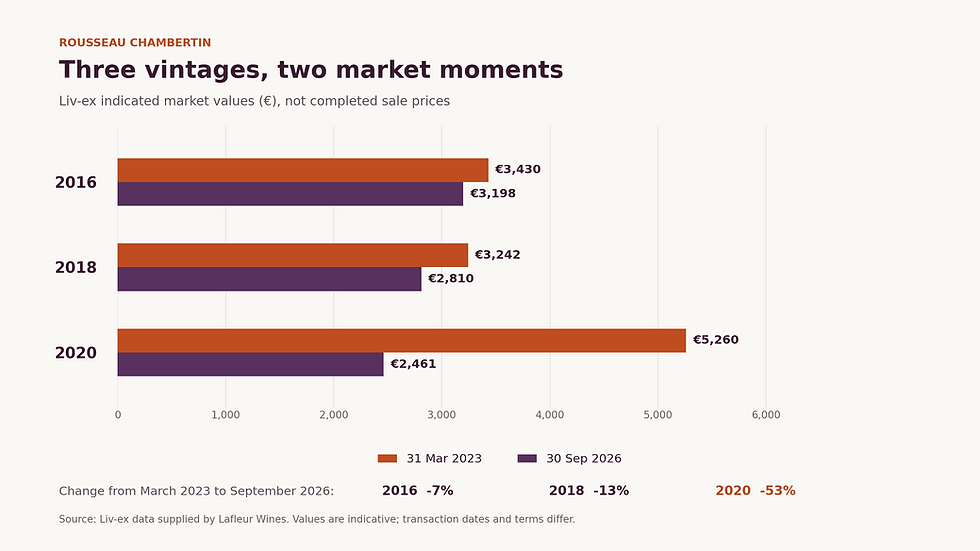
These are changes in Liv-ex market values, not realised investment returns: acquisition costs, storage, commissions and the price actually obtainable in a sale would all matter. Three vintages alone cannot prove why each price moved. Their different paths are, however, consistent with a pandemic-era premium in the 2020 that could not survive the correction.
The recorded trades give the comparison a further check, while requiring care with dates. The snapshot lists a trade in a case of six 2020s on 10 March 2026 at €2,475 per 75cl bottle, against €2,779 for the 2016 on 30 April 2026 and €2,330 for the 2018 on 24 August 2025. These are actual transactions, unlike the indicated market values, but they took place at different times and cannot be treated as three simultaneous offers. The distinction matters more than a superficially neat performance figure.
My refusal concerned the price attached to this wine in that market. Prestige, youth and the recent bull market could not justify paying more than €5,000 when comparable vintages offered other ways to own the same grand cru.
At that price, an investor needed the market’s enthusiasm to persist merely to have a credible path to appreciation. The subsequent divergence shows the cost of relying on that enthusiasm. It also explains why a purchase can be sensible later at a different price without making the original refusal mistaken.
Ask who will buy at the next price
The prospective buyer of a case in ten or twenty years will have choices too. That person may prefer a vintage entering its drinking window, a more acclaimed year, an original case with documented custody, or a different wine altogether. A producer’s reputation creates a potential audience, while the particular vintage, format, condition and asking price determine how much of that audience will actually engage.
Rarity and market depth can diverge at the top of the market. Before accepting a valuation, I would look for three things:
Trading evidence: Are there bids or completed trades near the indicated price for comparable stock, or only offers that have not found buyers?
Vintage alternatives: What other years can the next buyer choose, and what would justify paying more for this one?
Capacity to wait: Can the owner hold the wine if bids disappoint, without being forced to sell at the wrong moment?
A wine can be difficult to obtain and still be slow to sell at the valuation printed in a report. Prestige deserves a place in the review, though it cannot settle the exit price.
Time cannot repair every entry price
Wine can gain depth with age as its supply contracts. A bottle of Rousseau Chambertin 2020 held carefully until 2040 will offer a different experience from one opened today, and fewer bottles from the original production will remain. Those qualities may support a premium if collectors continue to seek the wine. They cannot tell an investor how long it will take to recover an excessive purchase price.
That is the temporal risk the 2020 made visible. A buyer who paid above €5,000 could plan to hold for decades, but the first years were spent absorbing a repricing rather than gaining the benefit of maturity. A long horizon grants the option to wait; it does not erase the distance between an expensive entry and the next buyer’s acceptable price. Demand can weaken, another vintage may become more attractive, and the wine itself can eventually move beyond its best drinking years.
The investor should therefore test the purchase against a less generous future market. If it would take another period of exceptional enthusiasm for the price to work, the margin for error is thin. Patient ownership is valuable when it lets a family choose when to drink, sell or transfer a wine. It is a poor substitute for a disciplined acquisition price.
Check the wine behind the quoted price
Even a sound comparison across vintages can fail if the bottles differ in condition and history. A case in original packaging with documented professional storage presents a different proposition from bottles that have travelled between private cellars. Format, duty status and transaction terms also matter. The Liv-ex table makes the 2020 premium plain, but a client’s actual acquisition still requires a review of the particular stock and the price at which it can be secured.
Ownership preserves that comparability over time. Original packaging where possible, credible custody, insurance and records of purchase help a later buyer understand what is being offered. They do not turn an overpaid wine into a profitable one; they prevent avoidable doubts from compounding the original pricing mistake. Our fuller article on investment risk examines custody, concentration and exit readiness in more depth.
Decide what the purchase is for
Someone may have bought the 2020 above €5,000 for the pleasure of owning this particular wine and would gladly keep it even if its market value fell. That can be a coherent purchase. A family may wish to follow its evolution, open it together and hand a bottle to the next generation. That personal value is real, though no later buyer is obliged to pay for it.
An investment mandate asks a different question of the same bottle: is the current price justified by its quality, its alternatives, its likely buyers and the time capital may remain committed? The collector is free to pay for an experience; an adviser needs a defensible entry point. The difficulty begins when a purchase made for desire is explained afterwards as though the market had guaranteed a return.
At the level of an individual acquisition, the test is quite personal. Would I still want this wine if its market price failed to rise for several years? Would I pay the same amount if a more mature Rousseau vintage were available for less? Could someone who inherits the case understand why it was chosen and what choices remain? Those answers may justify the purchase, change its size or lead to a patient refusal.
What the 2020 teaches about price
Rousseau Chambertin 2020 remains an extraordinary wine. My refusal to buy it above €5,000 was a judgement about a particular entry point at the end of a powerful bull market. The older vintages offered no weaker case on the published scores and considerably less demanding prices. When the correction came, their indicated values held up much better. A different price later, a different client or an acquisition intended for personal pleasure could lead to another conclusion. The discipline lies in making those circumstances explicit before prestige does the deciding.
The discipline is to place the wine in its market cycle, compare real alternatives and inspect the particular bottles before deciding what to pay. Those checks leave room for pleasure as well as financial judgement. They allow someone to admire a bottle and still decline the price attached to it.
For the wider picture of how we approach acquisitions, our Fine Wine Investment overview and How It Works explain the process, and the Fine Wine Investment Calculator lets you compare how producers and vintages have actually performed.
If you are weighing a significant Burgundy purchase, or revisiting one made near the market peak, I can help compare the available vintages and test the price against the stock you would actually acquire. We can start with a private conversation about your collection and the decision in front of you.

