
Why Provenance Is Critical for Long-Term Portfolio Value
Authentication technology has advanced considerably, yet fine wine still lacks a common system for documenting a bottle’s identity, ownership and condition throughout its life. For investors, the challenge is not choosing between technology and traditional provenance, but understanding what each form of evidence can genuinely establish.
A collector may hold a perfectly authentic bottle of Emmanuel Rouget’s Cros Parantoux and still struggle to present it convincingly to a future buyer. The wine may have left the estate through an official distributor. The label, capsule and cork may all be correct. Yet if the original invoice has disappeared, the storage history is uncertain and the bottle has passed through several undocumented hands, its authenticity alone will not resolve every question raised at resale.
The reverse is also true. A bottle may carry an NFC chip, a numbered security seal or a digital certificate, but none of these necessarily proves that it has been stored correctly since release. Technology can establish identity, detect interference or record selected events, but it rarely tells the entire story. For an investor, this distinction is fundamental. Authentication identifies the bottle, provenance explains its life.
Authentication and provenance are not interchangeable
Fine wine provenance is often discussed as though it were a single attribute. In reality, a future buyer is considering several different questions at once. Did this bottle originate from the estate? Has it been opened, refilled or altered? Who has owned it since release? Through which merchants, distributors or auction houses has it travelled? Where was it stored, and under what conditions? Does the seller have the legal and documentary authority to transfer it?
Different technologies answer different parts of this enquiry. A tamper-evident seal may indicate that the capsule has remained intact. An NFC chip may connect the bottle to a producer-controlled database. A temperature sensor may establish that a case avoided damaging heat during a particular journey. A blockchain record may preserve the ownership events entered into it.
Each can add valuable evidence, but none should be mistaken for complete provenance. An immutable record remains only as reliable as the information placed into it, while an authentic security device cannot describe events that were never recorded.
This becomes especially relevant with older wines. A digital identifier applied at the estate may provide a credible starting point, but a bottle held for twenty years will acquire a history extending well beyond the original act of authentication. Its future commercial value will depend upon how well that later history has been preserved.
Many initiatives, but no common language
The wine industry has not ignored the problem. Over the past decade, estates, merchants, auction houses and technology providers have introduced an expanding range of solutions, including serial numbers, BubbleTags, QR codes, NFC chips, RFID inventory systems, digital certificates, temperature monitoring and blockchain-based ownership records. What has not emerged is an agreed standard.
Domaine du Comte Liger-Belair has equipped its back labels with Selinko NFC authentication technology since the 2015 vintage. Older bottles leaving the domaine after 1 July 2017 have also received the system, allowing a collector to scan the chip and verify the bottle against the domaine’s records.

Domaine Georges Roumier has followed a different route, using coded security strips across the capsule that can be scanned to establish whether a bottle appears to have been tampered with. Christophe Roumier has himself recognised both the value and the limitations of the system, observing that a convincing imitation might still deceive someone who looks at the strip without actually verifying it.
Domaine de la Romanée-Conti places far greater emphasis on the integrity of its official distribution network. Its public warning on counterfeiting advises buyers to purchase through known official distributors and the merchants selected by them, describing this route as the only reliable guarantee of authenticity and proper conservation.
These approaches are not merely different technical versions of the same system. They reflect distinct philosophies about how trust is created and maintained.
Comte Liger-Belair provides the bottle with a digital identity that the owner can interrogate directly. Roumier uses physical tamper evidence. DRC continues to place considerable weight on the route through which the bottle entered the market and the relationships surrounding its distribution.
At the time of writing, we have identified no publicly documented estate-level NFC, Prooftag, BubbleTag or comparable consumer-facing bottle authentication programme at Armand Rousseau, Denis Mortet or Sylvain Cathiard. This should not be interpreted as evidence that these domaines apply no confidential security measures. Some estates deliberately disclose only part of their anti-counterfeiting arrangements, as Château Margaux expressly acknowledges in describing safeguards that remain confidential.
For investors, the conclusion is clear. Some of the world’s most desirable and investable wines coexist with radically different levels of visible authentication technology.
Technology should inform selection, not define investability
It would be understandable for an investor, concerned about fraud, to decide that only bottles carrying an NFC chip should enter the portfolio. The intention would be prudent, but the resulting investment universe would be frustratingly narrow.
A rule requiring one particular technology could exclude DRC, Armand Rousseau, Denis Mortet, Sylvain Cathiard and numerous other estates whose market standing, scarcity and long-term collectability are not dependent upon a publicly accessible digital passport. The investor would have replaced one risk with another. The risk of weak authentication would have been reduced, but only by introducing a rigid selection criterion disconnected from wine quality, price positioning, production, liquidity and future demand.
The absence of an NFC chip does not make a bottle inherently doubtful. Equally, the presence of a chip does not establish that the wine was purchased well, stored correctly or held within a coherent chain of custody. At Lafleur, our view is that technology should be treated as one layer of evidence within a broader assessment. Investors should require credible provenance, but they should not confuse one specific form of proof with the entire concept.
What estates are trying to protect
The concerns of producers deserve to be understood. An estate may spend generations building a reputation that can be damaged quickly by a single convincing counterfeit, a refilled bottle or a poorly stored wine presented under its label. Authentication technology can help establish that a bottle originated from the producer and has not been visibly interfered with. It can also discourage counterfeiters, reassure collectors and provide the estate with a direct means of communicating information about the wine.
For some producers, traceability also provides visibility over distribution. Technology suppliers openly present their systems as tools for identifying unauthorised exports, parallel markets and bottles appearing in territories or channels not selected by the estate. There is an understandable ideal behind this. The wine would leave the domaine, pass through the appointed importer or distributor and arrive with the person who will eventually open it. The bottle’s route would be orderly, visible and consistent with the producer’s commercial intentions.
The difficulty is that rare collectible markets do not remain static. Limited production and continued desirability create the conditions for ownership to change, sometimes repeatedly, across many years. The same dynamic exists in art, watches and classic cars. A collector acquires an object with a long-term intention, but wealth, taste, family circumstances and financial priorities evolve. A vintage Rolex Cosmograph Daytona may eventually pass to someone who was not present, or perhaps not yet collecting, at the time of its original release.
Authentication adds value when it protects the integrity of the object. It becomes less constructive when it is used to suggest that every legitimate resale represents a failure of distribution.
Direct ownership includes the freedom to sell
An investor may allocate capital to fine wine with the intention of holding for ten or fifteen years. Five years later, the portfolio may require rebalancing, a business opportunity may demand capital, or the original investment thesis may simply no longer reflect the investor’s objectives. In our view, resale in those circumstances is not a breach of loyalty towards the estate. It is a legitimate expression of ownership. The owner should retain the ability to hold, consume, transfer, pledge or sell the wines as personal circumstances and market conditions evolve.
We recognise that producers are entitled to protect their brands, select their primary distribution partners and discourage purely opportunistic behaviour around new releases. Yet once a bottle has been acquired legitimately, we do not believe its future should be constrained by an expectation that it remain indefinitely with its first purchaser.
The destiny of an investment asset should be shaped by market dynamics rather than restricted by controls imposed after the initial sale. Demand changes, price relationships evolve and new collectors enter the market. A wine may find its most committed owner many years after leaving the estate.
This is one of the reasons we regard a healthy secondary market as essential. It allows ownership to adjust over time and enables capital to move towards the wines for which demand is strongest. Restrictions that weaken this process may protect the appearance of orderly distribution, but they can also reduce liquidity, obscure price discovery and diminish the practical substance of direct ownership.
The secondary market gives fine wine its vitality
The vitality of the fine wine market is inseparable from the desires of its collectors. Scarcity alone does not create a market. A market comes alive when several people continue to want the same wine, long after the original allocation has disappeared.
The secondary market is where a magnum of Domaine de la Romanée-Conti La Tâche 2015, preserved in its original wooden case, can suddenly reappear. It may have remained untouched in professional storage since release, invisible to the wider market until its owner decides that the time has come to sell. For another collector, who may never have had access to the original allocation, that appearance can awaken an entirely new ambition.
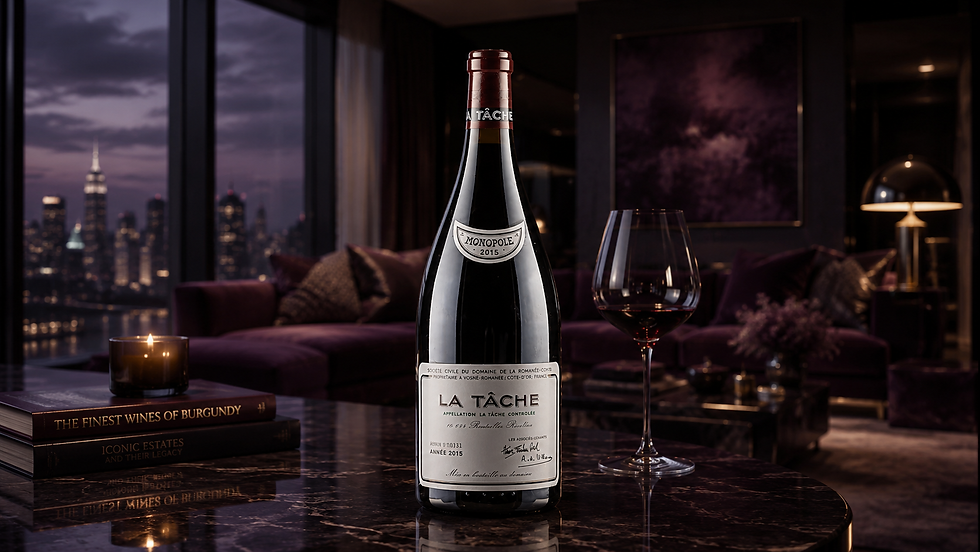
Such moments are part of the fascination of fine wine. The secondary market is not simply a mechanism through which ownership changes hands. It is where rare bottles resurface, dormant interest becomes active demand and collections acquire new direction. A wine first purchased in London may eventually join a cellar in Singapore, Geneva or New York, reaching an owner who was never part of its initial distribution.
The same dynamic exists in other collectible markets. A Ferrari 250 GTO may eventually pass to an owner who was not yet born when the car was built. Its value is not diminished by having changed hands. On the contrary, each legitimate transaction confirms that desire for the object has endured across generations.
Fine wine follows a similar logic. New collectors enter the market, existing collectors refine their tastes and portfolios evolve over time. A buyer who began with Bordeaux may later discover Burgundy or Piedmont. Why ? Because one evening an acquaintance opened a bottle of Cécile Tremblay’s Chapelle Chambertin Grand Cru 2010, a wine that was both admirable for its quality and fascinating for its market trajectory. The wine displayed its memorable Tremblay signature, dazzling aromatics supported by s structured yet elegant backbone. When the host explained that the wine had increased sixfold since he acquired it, the table fell silent. By the following morning, several guests were already searching for the few remaining cases.
Another collector may decide to consolidate several cases into a smaller number of exceptional large formats. At first, building a portfolio around original cases of six bottles priced between CHF 500 and CHF 1,000 per bottle may appear entirely appropriate. Over time, however, repeated annual allocations can leave the collection looking too uniform, built around the same format and price pattern. Rebalancing with magnums of Jean-Yves Bizot’s Échezeaux and attractively priced 600cl bottles of Château Margaux 2020 can suddenly give the portfolio another dimension. The secondary market allows these preferences to take shape, turning a collection from a simple accumulation of wines into something more personal, distinctive and strategically coherent.
Provenance beyond the primary market
The secondary market gives fine wine more than liquidity. It gives the market memory. Prices begin to reflect more than the enthusiasm surrounding a new release, absorbing the judgement of collectors, merchants, critics and investors over many years. Certain wines become harder to source, particular formats emerge as especially desirable, and some vintages strengthen their position as they move towards maturity.
For investors, this process provides essential visibility. The market reveals whether demand is broad or concentrated, whether pricing can be sustained, and whether sufficient buyers remain when an owner eventually chooses to sell. Liquidity is never automatic, but the secondary market allows it to be observed, assessed and cultivated.
The investment case would be easier to interpret if every new release represented the lowest price at which a wine would ever be available. Experience repeatedly shows otherwise. During the 2023 to 2025 correction, physically available Bordeaux back vintages, already carrying meaningful bottle age, could often be acquired on more attractive terms than newer wines still in barrel.
The years following release therefore have considerable strategic value. The market has time to absorb the initial supply, compare vintages and reconsider the relationship between quality and price. In some instances, the most compelling acquisition point appears two, three or even ten years after the wine first leaves the estate.
This creates an unavoidable tension around provenance. Buying directly from an estate, where access exists, may offer the cleanest possible origin and the shortest chain of custody. Yet an investment strategy built exclusively around primary allocations would leave the investor unable to respond to many of the opportunities created by changing prices, greater bottle maturity and improved market visibility.
Serious portfolio construction therefore requires the ability to return to the secondary market without lowering provenance standards. The question is not whether a wine has changed hands, but whether its history remains intelligible. Who originally supplied it? Has it remained in professional storage? Is the ownership trail documented? Does the packaging, condition and available paperwork support the account being presented?
At Lafleur, we do not view secondary-market sourcing as a compromise on provenance. We view it as a discipline requiring deeper examination. An attractive price is relevant only when the history of the wine is sufficiently clear for a future buyer to reach the same conclusion.
Authentication and traceability should strengthen confidence within this market, not limit its freedom. Technology that confirms identity, protects condition and clarifies ownership can elevate both trust and value. Yet no investor should be forced to choose between strategic opportunity and credible provenance. The role of careful sourcing is to preserve both.
Provenance remains an accumulation of evidence
Until the industry adopts a genuinely interoperable standard, provenance will continue to be assessed according to the information available for each particular wine. For one bottle, the strongest evidence may be an estate-applied NFC chip. For another, it may be a numbered security seal, an original invoice and an unbroken record of professional storage. For an older case, confidence may rest upon its original packaging and a merchant relationship extending through several generations.
This can appear untidy compared with the clean promise of a universal digital passport. Yet it reflects the reality of a market composed of thousands of independent producers, distributors, merchants, warehouses, auction houses and private owners.
Every estate has its own philosophy, scale, budget and commercial priorities. A small Burgundy domaine producing a few thousand bottles faces a different operating reality from a Bordeaux château distributing hundreds of thousands of bottles across numerous markets.
Even agreement on the technology would not settle every question. The industry would still need to determine who controls the data, who may update the record, how owner confidentiality is protected and what happens when a bottle moves between warehouses or outside the original platform.
There would also need to be clarity over whether a digital certificate constitutes legal title or merely supports it. A bottle may remain physically authentic while its digital record becomes incomplete, inaccessible or tied to a technology provider that no longer operates.
The industry is therefore far from having adopted a consensual solution. Numerous initiatives address the same underlying concerns, but they have been implemented largely in isolation, leaving the collector with a picture that is often technically sophisticated yet commercially difficult to read.
How Lafleur approaches provenance
At Lafleur Wines, we do not begin with the assumption that one technology can resolve every provenance question. We begin with the wine, the counterparty and the evidence available at acquisition.
We work with a selected network of industry-recognised merchants, distributors and specialist partners. Investment positions are sourced in full original cases or original estate packaging wherever applicable, rather than assembled from unrelated loose bottles whose histories may be difficult to reconcile. Where available, we retain anonymised evidence of the underlying transaction and establish the investor’s ownership from inception. The wines are then transferred into professional storage facilities with monitored temperature and humidity, while movements and inventory records are documented throughout the holding period.
This approach is deliberately practical. A future buyer should not be asked to rely upon an attractive valuation report while reconstructing the collection’s ownership and storage history from incomplete emails, misplaced invoices and fragmented warehouse statements. The chain of custody should be organised while the information is accessible, not recreated years later when the investor wishes to sell.
Technology forms part of this discipline where it is available. An estate-applied chip, numbered bottle or tamper-evident seal can strengthen the file attached to a position. It does not replace the need to understand who supplied the wine, how ownership passed and where the asset was subsequently held.
This is where provenance connects directly with exit readiness. The more clearly a collection can explain itself to a future merchant, auction house or private buyer, the less uncertainty that buyer must price into an offer.
Authentication technology will continue to improve. Chips will become more secure, digital records more accessible and condition monitoring more precise, all of which should be welcomed by serious collectors. Yet long-term portfolio value will still depend upon something broader: the ability to present a coherent and credible history of ownership, custody and preservation. Technology can strengthen that history, but it cannot manufacture it retrospectively.
For investors building or reviewing a substantial fine wine portfolio, provenance should therefore be treated as an operating discipline rather than a certificate collected at purchase. At Lafleur, that discipline begins with acquisition and continues throughout the life of the collection, so the wines remain intelligible, transferable and exit-ready from day one.


Comments