
Chateau Mouton Rothschild Investment: How the 1945 Vintage Became a Truly Scarce Asset
Updated: Apr 18
Chateau Mouton Rothschild investment rewards patience more than almost anything else in the fine wine market. The 1945 vintage is the clearest proof of this. It is not simply one of the most celebrated wines ever produced in Bordeaux. It is also one of the clearest examples of a broader truth: scarcity is not always immediate. In Burgundy, scarcity is often visible from the outset because production is tiny. In Bordeaux, especially among the First Growths, scarcity tends to arrive much later. It is time, not just production scale, that eventually transforms a famous wine into a truly rare one. Mouton 1945 is what that process looks like when carried to its logical extreme.
That is precisely why this wine deserves attention in the investment space. It challenges the simplistic idea that Bordeaux's larger production automatically limits long-term upside. In reality, great returns do occur in Bordeaux, but the timeline is often far longer than many investors would like. The wine must first pass through decades of drinking, attrition, damaged bottles, compromised storage, and shrinking market availability before effective scarcity begins to dominate pricing. With Mouton Rothschild 1945, that process was complete.
The birth of a myth: frost, war and the victory label
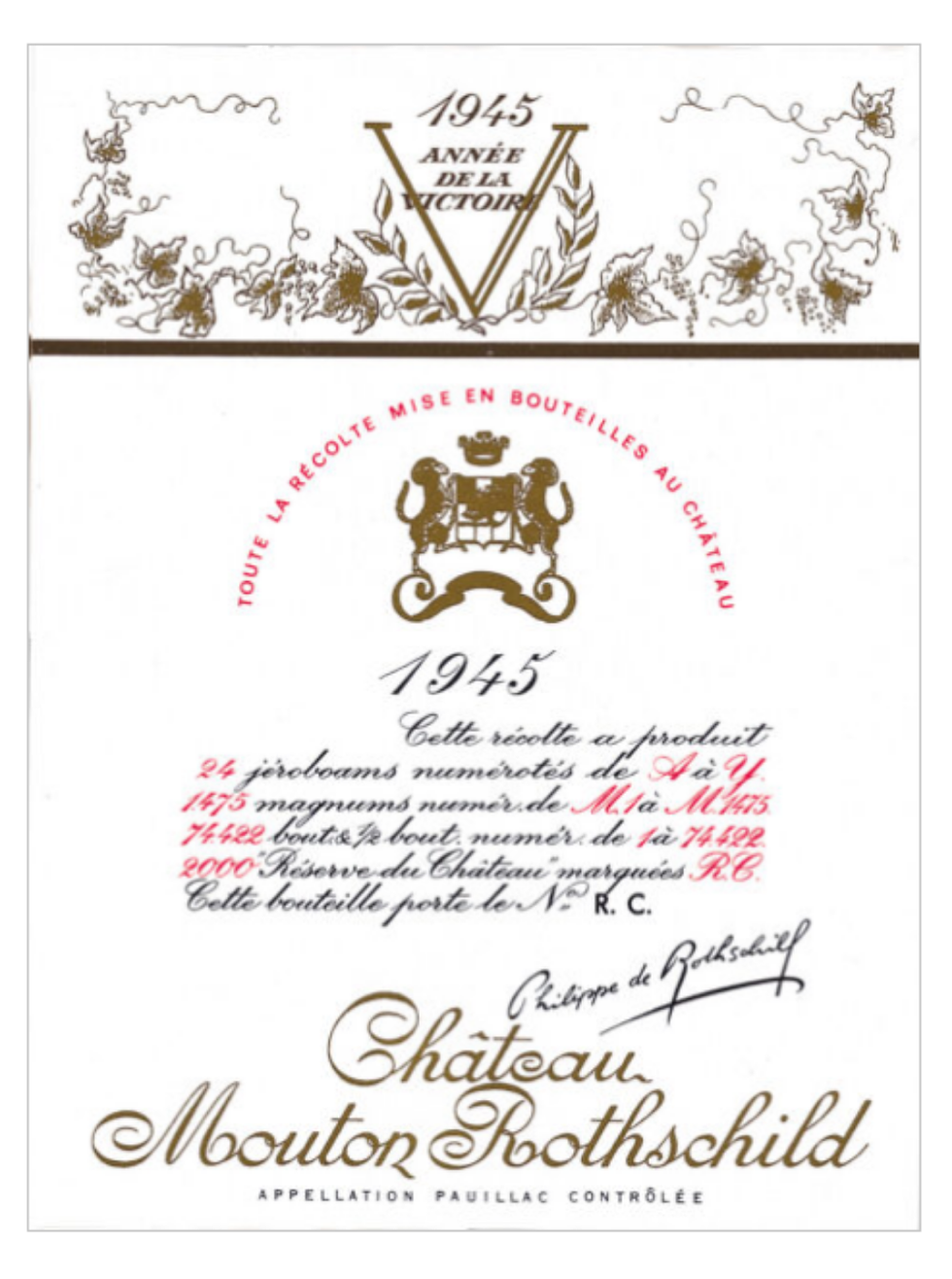
The 1945 vintage was extraordinary before the wine had even entered the cellar. Severe frost in early May drastically reduced yields across the Médoc, making 1945 the smallest Bordeaux harvest since 1915. What followed was a hot, dry season that produced intensely concentrated fruit. For Mouton, this combination of tiny crop and exceptional ripeness created the foundation for one of the most monumental wines of the twentieth century. Decanter's Wine Legend report cites roughly 74,422 bottles produced, plus 1,475 magnums and 24 jeroboams, while Christie's has referred to production of only around 6,000 cases. However you express it, this was a very small quantity for a First Growth, and one that eight decades of consumption have made dramatically smaller.
Its symbolic power was then sealed by Baron Philippe de Rothschild's decision to commission Philippe Jullian's famous "Année de la Victoire" label. This was not merely decorative. It marked the Allied victory and the end of the Second World War, while also inaugurating Mouton's enduring tradition of artist-designed labels. The wine therefore entered history not only as a great bottle, but as an object already charged with memory, politics and culture.
This is what gives Mouton 1945 such a singular force. It is not simply a great First Growth from a great year. It is a tiny wartime crop, attached to one of the most iconic labels in wine history, and protected by a symbolic charge that reaches far beyond the glass. The market is not reacting to quality alone. It is reacting to the fusion of wine, history and object.
Critics' scores: greatness confirmed over time
Many wines are praised in youth and disappointed later. Mouton Rothschild 1945 did the opposite. Robert Parker returned to it repeatedly with a 100-point score, calling it "one of the immortal wines of the century" and marvelling at its extraordinary density, opulence and youthfulness. Neal Martin's later encounters only deepened the aura. In 2018 and 2019, he again awarded the wine 100 points, describing one bottle as "monumental" and another as a wine of "hypnotic beauty," while noting signatures that have become part of the wine's mythology: menthol, eucalyptus, refinement, power and a near-endless finish. These were encounters more than seventy years after harvest, and still the verdict was perfection.
That continuity of critical admiration is rare. A wine may earn a perfect score once and then live on reputation. Mouton 1945 instead kept justifying it. The consistency of perfect assessments across decades reinforces the idea that this wine is not a nostalgic relic sustained by myth alone. It remains, by critical consensus, a fully alive benchmark.
A 100-year lifespan and the case for intergenerational wine investment
The most striking element in Neal Martin's later notes is not even the score itself. It is the horizon. In both the 2018 and 2019 tastings, he projected the wine as capable of ageing beautifully up to 2045. A wine harvested in 1945 was still being assessed in the late 2010s as having the potential to reach one hundred years of life in full dignity.
This is something to keep in mind when thinking about wine investment holding periods. Much of the modern conversation is built around five-year windows, ten-year holds, or tactical entry points after market corrections. Those considerations matter, but wines such as Mouton 1945 remind us that the deepest form of value creation often unfolds on a much longer scale. This is not merely a financial holding period. It is an intergenerational one.
A wine like this can be acquired, preserved and passed on to the next generation without losing relevance. In certain cases, it gains relevance precisely because time continues to strip away supply while deepening the symbolic and sensory charge of the surviving bottles. This is where wine begins to separate itself from most other luxury assets. A watch can be passed on. A painting can be passed on. But a great bottle of wine can be passed on while still evolving, still holding the promise of a future peak, and still fusing capital with culture.
Price evolution: when prestige becomes trophy-asset pricing
The market trajectory of Mouton Rothschild 1945 is not neat, but it is unmistakable. Because the wine is so rare and so sensitive to provenance, prices vary dramatically depending on storage, label condition, original ownership, château reconditioning and format. Jane Anson wrote in 2019 that she had seen the wine priced anywhere between £12,000 and £45,000 depending on provenance and market. More recently, Decanter's 2025 Left Bank collector's guide cited a guide price of $20,945 per bottle ex-tax.
Wine Searcher's global average price sits around €16,000 per bottle, but averages alone say little at this level. With a wine of this age, the spread between compromised stock and pristine stock is enormous. Provenance and preservation can move the market drastically, which is why one bottle may look merely expensive while another appears almost priceless. Auction evidence confirms the spread and cements Mouton 1945's trophy asset status: Christie's reported six bottles selling for HK$875,000 in 2023, and a single bottle made $81,250 in New York in June 2025.
At such extreme price levels, you may be wondering if prices still make sense. While scarcity will always be the key performance driver, the mechanisms of desirability strongly play in. For a deeper understanding of the psychology behind wine collecting, read here.
What Mouton 1945 reveals about First Growth wine investment and scarcity
Scarcity remains one of the most powerful drivers of long-term wine investment performance. That is one reason why Burgundy, with its tiny vineyard holdings and microscopic production, has often delivered stronger returns over shorter and medium-term periods than many larger-production Bordeaux wines. You can read more about which wines make the strongest investment case in our investor's guide to fine wine.
But Mouton Rothschild 1945 introduces an important nuance. Bordeaux should not be dismissed as insufficiently scarce. Rather, it should often be understood as slow scarcity. A First Growth may begin life with much higher production than a grand cru Burgundy, but if the wine is truly great, if the château's symbolic power endures, and if the vintage enters the realm of historical myth, then multiple decades of consumption eventually reduce supply to a point where scarcity becomes very real. At that stage, the wine begins to trade less like a liquid blue-chip and more like a trophy asset.
This helps explain why significant returns in Bordeaux do occur, but often only after a much longer wait. The market needs time to destroy abundance. In younger Bordeaux, there may still be thousands of sound bottles available. In a wine like Mouton 1945, the market is competing for survivors. That is a very different equation.
Where Mouton Rothschild 1945 stands in the investment space
Mouton Rothschild 1945 is not the archetype of the everyday investment-grade wine. It is too rare, too bottle-specific and too provenance-sensitive for that. It does not function as a routine portfolio component, nor as a convenient source of short-term liquidity. It occupies a higher and narrower category: the heritage asset, the trophy bottle, the endgame acquisition.
Yet its relevance goes far beyond the small circle of buyers capable of pursuing such a bottle. The real lesson of Mouton 1945 is not that one should chase unattainable trophies. It is that recently released benchmark vintages deserve to be viewed through a different lens. The most compelling reason to acquire them is not the hope of a quick return, but the opportunity to begin building something that may outlast the investor who first bought it.
A great young First Growth, properly sourced, professionally stored and patiently held, is more than a speculative position. It is a potential future heirloom. The objective is not merely to catch a price move over the next few years, but to participate in the long process through which a celebrated wine gradually becomes scarce, then historically resonant, and eventually worthy of transmission. In that sense, investing in top benchmark vintages is not short-term trading. It is the patient construction of a multi-generational legacy.
FAQ: Is Château Mouton Rothschild a good investment today?
Mouton Rothschild 1945 is more than a legendary bottle. It is proof that certain Bordeaux wines do become profoundly scarce, and that the highest levels of return may require patience measured not in years, but in generations.
Does that mean 1945 is worth investing in today? Provided provenance is impeccable and preservation beyond reproach, the case is certainly defensible. One could argue that the entry point has already risen so far that much of the upside has been captured. Yet with a wine of such stature, one that may continue to hold its ground well into the second half of the twenty-first century, certainty becomes elusive. At this level, the market is no longer pricing wine alone. It is pricing historical weight, rarity and survival.
Its valuation becomes even more striking when compared with younger benchmark vintages available today, often in meaningful quantities, trading in the mid hundreds rather than the tens of thousands per bottle. The contrast is instructive. It reveals not only the premium attached to 1945, but also the opportunity that lies in recent releases.
Few vintages will ever carry the same historical aura as 1945. But that is not the point. The more relevant question for investors is which of today's benchmark vintages may one day follow a similarly compelling trajectory. In that respect, Mouton Rothschild 2016 deserves serious consideration. With eight perfect 100-point scores, exceptional ageing potential, and pricing still roughly thirty times below the levels now associated with 1945, it stands out as the kind of wine that should be approached not with the expectation of quick returns, but with the ambition of building a multi-generational legacy.
If you’d like to talk through what a first step looks like, start here.


Comments