
Why You Need More Than a Wine Storage Cabinet
A wine storage cabinet is often where the conversation starts. But for serious collectors, it rarely ends there. This guide draws on a conversation with Jimmy K. Simmons of Vineyard Wine Cellars to explore the full range of wine storage solutions, from the integrated bar cabinet and mounted wine rack to the custom wine cellar, and explains why choosing how to store wine is one of the most important decisions a collector can make.
I first connected with Jimmy K. Simmons through social media. Over time, a distant conversation formed across the Atlantic, built around our shared passion for wine and our views on the wider fine wine ecosystem. I sensed there was more behind the comments, so I invited him for an interview. As strategic partner of Texas-based Vineyard Wine Cellars, I figured Jimmy was the top choice to discuss private cellars, refrigeration and the practical limits of a wine storage cabinet.
We surely did, but the conversation opened onto something far more interesting, on what it truly means to protect wine over time. Jimmy does not see himself merely as a cellar designer, but as the "protector of wine", a genuine mission that goes far beyond controlling temperature. For serious collectors, storage is not about filling a wine storage cabinet like you would fill your fridge with groceries. It is about deciding which bottles are for pleasure, which are for investment, which are for legacy, and how each should be preserved, documented and eventually passed on.

The Protector of Wine
Jimmy K. Simmons speaks like a man who has built things before learning how to explain them. His background does not come from the polished showroom version of luxury. It begins on job sites, working alongside his father at Simmons Masonry, reading plans, dealing with tradesmen and learning the kind of precision that cannot be faked. Then came music. He co-founded Street Toyz, became part of the Dallas rock scene and launched his own record label to stay independent. Later, a part-time job in a liquor store opened the door to more than a decade inside the wine trade.
My own professional path began far from wine, as a commercial fisherman in Alaska, before moving through freelance work and eventually into a trading firm, where I looked after the in-house wine collection. Perhaps this is why Jimmy's eclectic life path resonated so deeply. Moving hands-on through different worlds sharpens the eye in ways theory alone never could. Jimmy does not approach a wine room as a decorative object. He understands walls, weight, materials, clients, sound, light, showmanship and wine. He is a builder, a rocker, a designer and a wine man, all at once. He is also the kind of wine lover who named his daughter Maya after Dalla Valle's flagship wine. That detail says more than a brochure ever could.
When I asked him how he would define his role in the wine world, he could have spoken about architecture, design or technical execution. Instead, he went straight to the core. "I would say the protector of wine," he told me, with the calm conviction of a man on a mission. Between the lines, I felt that Jimmy's work is not only about building beautiful cellars, but about serving the larger purpose of protecting bottles whose value depends on time, patience and care. His vision immediately deepened the connection between us. We come from different places, operate in different parts of the wine ecosystem and approach the subject through different crafts, yet we seem to meet around the same conviction that wine is not merely a product to be bought, stored, consumed or sold, but a cultural asset entrusted to us for a period of time.
We are both driven by the same sense of responsibility. In our respective fields, we act as custodians, not only of the greatest wines, but of the culture behind them: the vineyards, the families, the vintages, the rituals, the patience and the accumulated human effort contained in each bottle. This is where Jimmy's vision connects so naturally with Lafleur's approach to wine investment. Returns matter, of course. They give the discipline its financial logic. But fine wine investment is not only about performance. It is also an act of stewardship. The investor becomes a custodian too, carrying bottles safely from one moment in time to another, preserving not just their market value, but the possibility that one day they will be opened, shared, understood and remembered. And you may need a little more than a wine storage cabinet to achieve that.
Not Every Bottle Is Built for Time
Before going further into cabinets, custom-built cellars and preservation, one truth has to be placed on the table. Not every bottle deserves the same level of protection, because not every bottle has the same relationship with time. Some wines are made to be opened within a few years. Some will improve with patience but may never become meaningful financial performers. A much smaller group belongs to another world entirely, where provenance, scarcity, brand power and ageing potential combine to create long-term investment relevance.
Jimmy works with a diverse client base in Texas and across the entire United States and insists on understanding each collector's objectives before putting forward a cellar proposal. Many collectors worry about storage before asking the more basic question: are the wines they own actually built to age? He mentioned clients who become anxious about protecting bottles that were never meant to be kept for decades. In those cases, the goal is not to over-engineer the storage environment, but to provide a fit-for-purpose solution that keeps the wines in proper condition until the right drinking moment arrives. Wine was made to be enjoyed. The mistake is not opening a bottle. The mistake is confusing every bottle with a future asset.
In reality, a serious collection is rarely one single thing. It usually contains three very different categories of wine, each with its own purpose, time horizon and storage logic.
The Wine Storage Cabinet is for Home Enjoyment Stock
The first category is home enjoyment stock. These are the wines you want near you. They may be mature Second Growth Bordeaux, like a 2010 Rauzan-Ségla, value-driven bargains such as Grand-Puy-Lacoste 2015, your Meursault Village from Drouhin, Ruinart Blanc de Blancs kept fresh for friends dropping by impromptu, a set of Vietti Barolos, or other bottles attached to memories, places and people. They can be highly qualitative without being obvious financial performers.
Their role is not to sit untouched in a warehouse until a future buyer appears. Their role is to live inside your home and be open at the right moment. For these wines, the wine storage cabinet integrated into your kitchen design may be exactly what you need. It gives access, pleasure and convenience without pretending that every bottle in the house must be treated like an institutional asset.
For home enjoyment stock, a well-designed wine bar cabinet or cabinet wine rack integrated into your living space often works beautifully. A mounted wine rack can display bottles with visual flair while keeping them accessible. A bar cabinet glass front adds presence to a room and lets labels speak before a bottle is ever opened. For something warmer and more traditional, an oak wine or wood wine cabinet brings craftsmanship and character to the space. If the room receives natural light, wine rack cabinets fitted with UV resistant glass protect bottles from light degradation while keeping the collection on show. These are all practical wine storage solutions that serve the home enjoyment category well without over-engineering the environment.

Investment Stock
The second category is investment stock. These are historically data-proven, top-performing wines selected with capital preservation and future resale in mind. We are talking about names such as Roumier's Bonnes-Mares, Sylvain Cathiard's Romanée-Saint-Vivant, large-format Château Lafite Rothschild in original wooden cases, Roagna's microscopic Barbaresco range, or, of course, Screaming Eagle. The list is long, yet the category remains extremely narrow.
Top-tier investment-grade wines represent only a fraction of global production, and it is around this rare fraction that Jimmy's mission and mine most clearly converge. Here, the logic changes. These wines sit at the intersection of culture and finance. They remain emotional, alive and culturally charged, but they are also assets. Original cases matter. Storage history matters. Market liquidity matters. The future buyer must be able to trust not only the producer and the vintage, but the entire journey of the bottle from acquisition to resale.
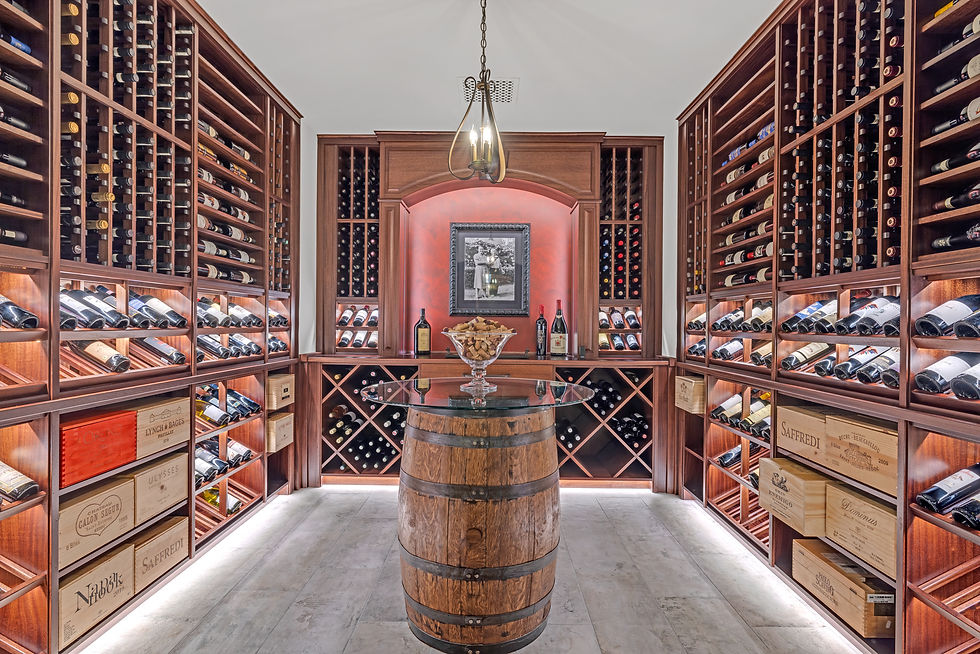
For investment stock, format matters considerably. Bordeaux bottles in original wooden cases, sealed and documented, carry significantly more market confidence than bottles that have been repackaged or separated. At this level, a custom wine storage environment should not be treated as a decorative shell, but as a purpose-built custody space. This is where the custom-built solutions designed by Vineyard Wine Cellars are especially relevant. Rather than relying on generic, one-size-fits-all answers, Jimmy’s approach begins with the room, the collection and the owner’s objectives, before shaping refrigeration, airflow, humidity control, monitoring and case accommodation around the specific role the cellar is meant to play.
Legacy Stock
The third category is legacy stock. These are the bottles bought with a horizon that may extend beyond the owner's own drinking window. They are ultra-long ageing wines that may need decades before they fully become icons. Their future value may not appear quickly. Their meaning may not even belong entirely to the person who buys them. These are wines that can be passed on, held in silence, and eventually opened or sold by another generation.
They sit somewhere between investment, memory and inheritance. A good example is Château Mouton Rothschild 1945, a monumental wine that, according to critics, should still deliver mesmerizing pleasure at its centennial anniversary, provided the bottle has been stored perfectly throughout its life. This is not the same storage question as keeping a few bottles ready for dinner next weekend. Here, storage becomes part of the wine's destiny.
The Storage Question Changes Once the Wine Has a Role
Once these categories are clear, the storage question changes completely. A wine storage cabinet may be perfectly suited to part of the home enjoyment stock. A private cellar may bring pride of ownership, tactile pleasure and the joy of living with wine. Professional storage may be the more rational route for investment stock, especially when future resale is part of the plan. Legacy stock may require the most patient thinking of all, because the goal is not only to preserve wine, but to preserve time itself.
This is why there is no single answer to wine storage. The best solution depends on what the bottle is supposed to become. Some wines should be close enough to touch. Some should be kept away from temptation. Some should remain in original cases, professionally stored and quietly documented. Some may deserve a future storage philosophy we are only beginning to imagine.
The Cake and the Icing
The Invisible Architecture of Preservation
Once the role of each bottle is understood, the next question is how to build the environment around it. If you are serious about wine collecting and feel ready to move beyond improvised storage, this is where Jimmy's work at Vineyard Wine Cellars becomes relevant. He does not speak like someone trying to sell a beautiful room. He speaks like someone who knows how easily wine can be compromised when the invisible parts of a project are treated casually, especially in an industry that too often sells speed where care is needed.
Jimmy shared his concerns about the American appetite for immediacy, the "click and receive" mentality that has found its way into wine storage as much as everything else. In his view, too many businesses sell racks, cooling units and modular answers before taking the time to understand the wine, the room or the owner. The consequences may not appear on day one. They emerge later, through condensation, mold, uneven cooling, failing systems and disappointment.
In this light, Jimmy's repeated insistence that his "primary focus is to protect the liquid asset" takes on its full meaning. The visible beauty of a cellar matters, of course, but only after the wine itself has been properly protected. For him, everything starts with the invisible architecture of preservation, the envelope, the refrigeration, the airflow, the humidity, the sizing and the discipline behind the installation. The rest, as he put it, is "the icing."
The Cake Before the Icing
A wine space, he explained, is like baking a cake. The cake has to be right before the icing matters. In cellar terms, the cake is the structure beneath the beauty. It is the envelope, the refrigeration, the airflow, the humidity, the sizing and all the technical decisions that allow the room to behave properly over time. The icing is what most people notice first: the brass, the bronze, the leather, the acrylic, the glass, the lighting and the visual drama.
That image says almost everything about Jimmy. He enjoys the beauty, but he does not trust beauty on its own. He knows that wine is fragile, even when the bottle looks solid, expensive and immovable. A great label can give the illusion of permanence, but inside the glass the wine remains alive, slowly changing, responding to heat, cold, humidity, light, vibration and neglect. The liquid asset may look silent, but it is not inert. It depends on the world built around it.
This is why Jimmy insists on the needs assessment before the proposal. He wants to know whether the client is a consumer, a collector, an investor, or some combination of all three. He wants to understand what the client owns, what he intends to own, how the wines will be used and whether the space requires one refrigeration system, full redundancy, or something more tailored. In his words, you need to "dial their envelope, their cake into what's best for their needs." That is not a sales language. It is the language of someone who understands that a wine room is not a decorative box, but a controlled environment with consequences.
Why This Matters for Wine Investors
That is where his character comes through most clearly. Jimmy is not precious, but he is demanding. He has the bluntness of a builder and the sensitivity of a wine lover. He can talk about leather, acrylic and lighting, but he keeps returning to refrigeration, airflow and the envelope because he knows those invisible decisions carry the real responsibility. A cellar that looks magnificent but fails technically is not luxury. It is a risk disguised as luxury.
For wine investors, the lesson is direct. A portfolio may look impressive because the names are great, the vintages are strong and the formats are desirable. But if the bottles are not stored, monitored, insured and documented properly, the investment logic weakens. In wine, value is never attached only to the label. It is attached to the condition of the bottle, and that condition depends on the quiet discipline of preservation.
Jimmy's cake-and-icing metaphor therefore reaches beyond cellar design. It applies to wine ownership itself. The icing is what the collector enjoys showing: the glass wall, the rare labels, the spectacular room, the sense of theatre. The cake is what gives those bottles a future. Without the cake, the icing is just decoration. With the cake properly built, beauty finally has something worth protecting.
The Cellar as a Gallery
Luxury Is a Feeling
What makes Jimmy interesting is that he is not dismissive of beauty. He is not the technician who rolls his eyes at design, nor the builder who sees aesthetics as superficial decoration. He loves the visible part too. He understands the pleasure of walking into a wine room where the lighting is right, the materials speak quietly, the bottles seem to float in space and the whole room creates a sense of occasion. But he also understands that luxury cannot begin there.
At one point in our conversation, Jimmy explained that he had to learn the codes of luxury. As his career became more serious and his projects moved deeper into the world of ultra-high-net-worth collectors, he realized that luxury was not simply about the object itself. "It's not a thing," he told me. "It's an experience. It's a feeling." That sentence stayed with me because it could apply just as naturally to wine investment.
The greatest bottles are not valuable only because they are rare, expensive or highly scored. They are valuable because of what they allow us to feel: continuity, patience, beauty, status, history, memory and anticipation. A bottle of wine is an object, of course, but the desire around it is never only material. It carries a form of emotional electricity, and that electricity is intensified by the way the bottle is kept, shown and eventually shared.

Wine, Like Art, Needs Presence
During the interview, I told Jimmy that I love touching bottles. I love looking at labels, holding them, reading them, remembering where they came from and imagining when they might be opened. A bottle can carry emotional force before the cork is pulled. It can remind us of a region, a dinner, a person, a trip, a vintage, a decision made years earlier.
Jimmy immediately understood. "It's tactile," he said. "If you have a passion for wine and you love wine, it's like art. If you love art, you're going to want to look at it." That comparison is exact. A work of art does not speak in the same way when it is hidden in storage, badly lit or hung without care. Its power depends not only on the object itself, but on the space that allows it to be seen.
Wine works in a similar way. The label is not the wine, just as a frame is not the painting. But the label opens the imagination before the wine is tasted. A bottle of Lafite, Rousseau, Roumier, DRC or Mouton does not need to be opened to speak. The name alone can awaken memory, desire and expectation. The eye sees the label, the mind fills the cellar, the vineyard, the vintage, the history and the future moment of opening.
The Label as Emotional Architecture
This is why a wine cellar is not just a storage space. At its best, it becomes a gallery of time. The bottles are not merely arranged. They are presented. The labels are displayed like fragments of cultural memory, each one carrying a place, a producer, a year and a promise. The cellar becomes a room where wine can be contemplated before it is consumed.
This may sound romantic, but serious collectors understand it instinctively. They do not only want to own bottles. They want to live with them. They want to see the labels, recognize the vintages, remember the acquisition, anticipate the dinner and imagine the evolution. The cellar gives physical form to that relationship. It turns inventory into presence.
This is also where luxury becomes subtle. The point is not to build the loudest room or the most spectacular wall of glass. The point is to create a space where the owner feels connected to the bottles, to the time they require and to the story they carry. A technically correct but soulless cellar may protect wine, but it may fail to create emotion. A visually stunning cellar that fails technically may seduce the eye while betraying the bottle. The best wine spaces do both. They protect the wine and deepen the owner's relationship with it.

From Storage to Experience
A wine storage cabinet can keep bottles cool. A custom-built cellar can protect them at scale. But a great wine space does something rarer. It gives the collection a presence. It allows wine to be lived with, contemplated, shared and remembered before the bottle is even opened.
This is why Jimmy's understanding of luxury feels so closely aligned with the logic of fine wine itself. The liquid matters, but so does everything around it: the label, the vintage, the memory of acquisition, the patience of storage, the moment of opening, the people at the table and the feeling that something irreplaceable has been carried safely to its proper hour.
The private cellar therefore sits between protection and emotion. It guards the wine, but it also stages the relationship between the owner and the collection. In that sense, it is closer to a gallery than to a pantry. It is where bottles wait, but also where they speak.
When Resale Enters the Room
Provenance Is Built Before the Sale
There is one moment when the romance of the private cellar meets the discipline of the market. It comes when the owner decides, or even imagines, that some of the bottles may one day be resold. At that point, beauty, pleasure and pride of ownership are no longer enough. The future buyer will not only ask what the wine is. He will ask where it has been, how it has been kept and whether the story can be trusted.
Jimmy made this point with disarming clarity. If someone arrived at Sotheby's or Christie's with ten cases of DRC, the first question would not be about how beautiful the private cellar looked. It would be about pedigree. Where has the wine been? How long has it been owned? Can the seller prove the wine?
That phrase, "prove the wine," should sit at the center of every serious wine investment conversation. A bottle may come from the right producer, the right vintage and the right format, but if its journey is unclear, doubt enters the room. In wine, doubt has a cost. The buyer may still be interested, but he will price the uncertainty.
The Ferrari Problem
Jimmy used another image that captures this perfectly. Some clients arrive with inspiration pictures without realizing they are looking at a Ferrari. They see the glass, the lighting, the atmosphere and the drama, but not always the engineering behind it. A Ferrari is not only a beautiful object. It is a machine that requires the right maintenance, the right specialist attention and the right record of care.
The same applies to serious wine storage. A spectacular cellar may impress guests, but if it cannot demonstrate that the wine has been properly protected, it may fail at the exact moment when proof matters most. Luxury without maintenance records is fragile. Wine without a storage record is exposed.
Monitoring Is a Form of Insurance
This is where monitoring becomes essential. For collectors who may eventually resell wines kept in a private cellar, temperature and humidity monitoring should not be seen as a gadget. It is a form of insurance. It protects value by creating a record of care.
A top-end monitoring system does not simply tell the owner whether the cellar feels cool today. It records the conditions over time. It shows whether temperature remained stable, whether humidity stayed within acceptable levels, whether any incident occurred and how quickly it was addressed. The point is not only to protect the wine physically, but to protect the credibility of the wine's story.
For investment-grade bottles, this matters. Original cases matter. Storage history matters. Market liquidity matters. But if the wine has been held privately, then data can help bridge the gap between personal custody and market confidence. A future buyer may not treat a private cellar like professional storage, but a seller who can show years of stable records is in a far stronger position than one who can only say the wine was well kept.
Anticipating the Future Buyer
The best time to think about resale is not when you decide to sell. It is when you decide where the wine will sleep. That is the discipline many collectors overlook. They build the room, fill the racks, enjoy the view, and only years later ask whether the bottles can be sold at full value, by which point part of the story may already be missing.
If resale is even a possibility, storage should be planned with the future buyer in mind. The cellar should be properly designed. Conditions should be monitored. Records should be retained. Inventory should be accurate. Movements should be limited. High-value wines should remain in their original cases when possible. Bottles held for investment should be separated, mentally and physically, from bottles held for dinner.
The objective is not to remove the pleasure of ownership. It is to protect optionality. A collector may choose to drink, sell or pass bottles on. But each option becomes stronger when the custody story has been respected from the beginning.
From Private Pleasure to Market Confidence
Professional storage remains the cleanest solution for investment stock, especially when future resale is already part of the plan. Jimmy recognizes this, even though his own business is private cellar design. That balance is precisely why his view carries weight. He understands that the private cellar and professional storage do not compete. They serve different roles.
A private cellar gives presence, pride and emotional access. Professional storage gives market confidence. Monitoring sits between the two. It allows privately held wine to build a more credible preservation record and gives the owner a stronger story if the bottles ever return to the market.
That is the final reason why a serious collector needs more than a wine storage cabinet. The cabinet may hold bottles. The cellar may display them beautifully. But value is protected through anticipation, documentation and care. If wine is to be enjoyed, it should be kept well. If wine is to be sold, it should be provable. If wine is to be passed on, it should arrive with its story intact.
Jimmy's work begins with rooms, but the deeper subject is continuity. He protects bottles before they are opened, sold or inherited. That is also where his mission meets the philosophy behind Lafleur Wines. Fine wine investment is not only about acquiring the right names. It is about preserving the conditions that allow those names to remain meaningful through time.
The finest wines are never simply stored, but entrusted to those willing to protect their journey through time.
Choosing the Right Wine Storage Solution
The right wine storage solution depends entirely on what you own and what you intend to do with it. A wine storage cabinet suits bottles you want nearby. Wine rack cabinets fitted with UV resistant glass work well for display-focused collections in rooms with natural light. A mounted wine rack or a wine bar cabinet with bar cabinet glass serves the home enjoyment category well, keeping bottles accessible while adding visual character to a room. A wood wine or oak wine cabinet brings warmth and craftsmanship to a domestic space.
For collections that include investment or legacy stock, the calculation shifts. Custom wine cellar design and a carefully controlled cellar wine environment become the appropriate tools. At this level, how you choose to store wine is not a secondary consideration. It is part of the investment itself, and it shapes every conversation that follows, whether that conversation is about drinking, selling or passing bottles on.
You can read more about which wines are worth protecting at this level in our guide to the best wines for investment, and explore the full picture of how storage sits within a wine investment strategy in our fine wine investment guide.
Wine Storage Cabinet Questions:
What is the difference between a wine storage cabinet and a wine cellar?
A wine storage cabinet is a self-contained unit that holds bottles at a stable temperature. It suits home enjoyment stock and shorter-term storage well. A wine cellar, whether custom-built or professional, is a purpose-designed environment capable of protecting investment-grade and legacy bottles over decades. The difference is not only scale but intent.
What temperature should a wine storage cabinet be set at?
Most wine storage cabinets should be set between 10°C and 14°C (50°F to 57°F). Red wines typically prefer the higher end of that range, white wines and Champagne the lower. If you are storing a mixed collection, 12°C is a widely used compromise. The more important factor is stability: a constant temperature with minimal fluctuation is more protective than chasing a precise number.
Is UV resistant glass important in a wine storage cabinet?
Yes. UV light degrades wine over time by breaking down the organic compounds responsible for flavour and ageing potential. A wine storage cabinet or wine rack cabinet with UV resistant glass protects the collection from light exposure while still allowing labels to be seen. For display-focused storage in rooms with natural light, it is not optional.
Can a wine storage cabinet be used for investment-grade wine?
A quality wine storage cabinet can provide adequate short-term protection for investment stock, but it is not the recommended long-term solution for serious investment-grade bottles. Original cases, humidity control, monitoring records and chain of custody all matter when resale is part of the plan. For that level of collection, a custom wine cellar or professional bonded storage provides a more credible preservation record in the eyes of a future buyer
Can Vineyard Wine Cellars help me build a private cellar?
Yes. For collectors considering a serious private wine cellar, Vineyard Wine Cellars offers custom-built solutions designed around the room, the collection and the owner’s objectives. Jimmy K. Simmons’ approach begins with preservation first, then integrates design, materials, lighting and the emotional experience of living with wine. If you are planning a private cellar, wine wall or luxury wine storage space, contacting Vineyard Wine Cellars is a natural next step.


Comments