What Does Wealth Choose to Preserve? Terroir, Celebrity and the Future of Fine Wine

Wealth gives its owner the means to influence what survives: which places remain cultivated, which traditions are carried forward and which cultural objects retain an audience. Fine wine makes that influence unusually visible. Its most enduring examples are attached to particular sites, while its public image is increasingly shaped by personalities and brands that can travel quickly across media. Celebrity can help a place find new admirers. The deeper question for collectors, investors and families is where that attention leads: towards an identity grounded in an irreproducible site, or towards a story whose appeal depends chiefly on visibility.
Capital makes a cultural choice
A purchase is an allocation of capital. It may also be an expression of what its owner believes will matter in the future.
For a family office, wealth adviser or private investor, that choice is usually tested against familiar questions: expected return, liquidity, risk, diversification and time horizon. Cultural assets introduce another question. What does the capital help carry forward? A collection of wine can preserve a record of places, vintages and human decisions that would otherwise disappear from everyday experience.
Fine wine brings these questions together because the bottle carries two kinds of value. It is a traded asset, whose price depends on quality, scarcity, condition and demand. It is also the surviving expression of a particular harvest, site and culture of making. The financial case must be tested rigorously; the cultural meaning can be part of the reason to own it.
This distinction matters to investors whose portfolios already contain businesses, property and financial assets. The question is not whether wine is more meaningful than those holdings. It is whether a carefully chosen wine allocation contributes something distinct: direct ownership of finite objects whose identities are bound to specific places and whose history can be experienced, shared or passed on.
The paradox of relevance
Wine is often asked to become more relevant to people who did not inherit its vocabulary. “Terroir” can sound abstract or exclusive; a familiar face is immediately recognisable. A personality can make a product easier to notice, easier to discuss and easier to imagine as part of a contemporary life.
There is nothing inherently shallow about that appeal. Recognition is one way people begin to care. A celebrity partnership may bring investment, technical expertise, new consumers and genuine ambition. A successful project may eventually develop a place-based identity of its own.
The tension appears when cultural visibility is treated as a substitute for the qualities that make a wine singular. Fine wine’s most durable scarcity is geographical. A vineyard can be cultivated more carefully, its grapes selected differently and its wine interpreted through new techniques. Its origin cannot be moved elsewhere and reproduced. The future of fine wine depends on whether the industry can make this kind of uniqueness understandable and desirable without reducing it to a label or a luxury code.
The International Organisation of Vine and Wine defines viticultural terroir through the interaction of an identifiable physical and biological environment with the collective practices applied there. That definition matters because it includes human knowledge alongside soil, climate and geography. Terroir is neither a static geological claim nor a marketing invention; it is a relationship between place and the people who learn how to work with it.
An address that cannot be transferred
The investment-grade wines that have earned lasting recognition are deeply attached to an address. Their names point towards a place whose identity has accumulated through cultivation, ownership, interpretation and time.
In Burgundy, Clos de Tart is a Grand Cru monopole: its 7.53 hectares have remained undivided through centuries of ownership. La Romanée-Conti and La Tâche are also monopoles. Other celebrated sites—Musigny, Clos de Vougeot, Romanée-Saint-Vivant and Richebourg—carry their own identities, shaped by the vineyard boundaries and the producers who interpret them. Naming these places does more than signal prestige. It identifies the source of a wine that cannot be recreated by planting the same grape elsewhere.
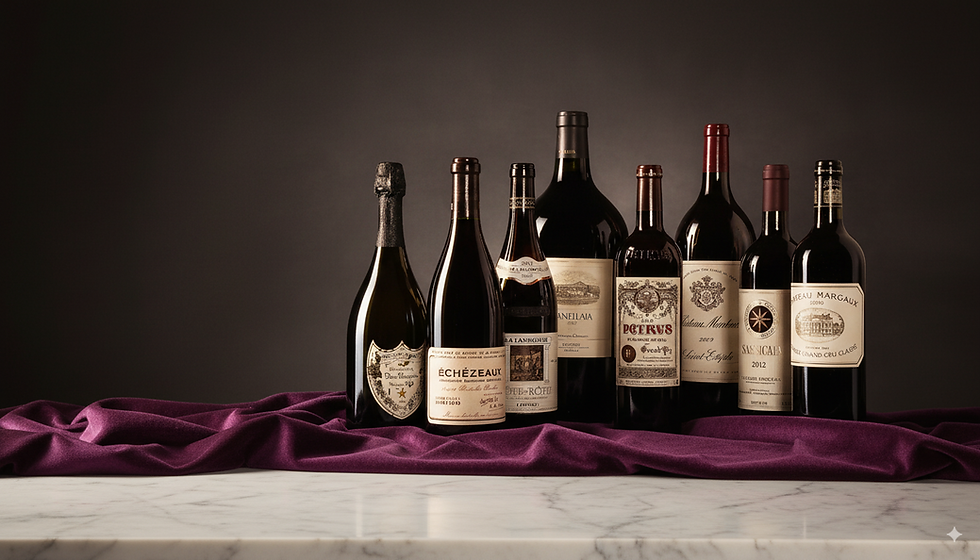
The same logic holds in Bordeaux, though the geography is expressed through both appellations and estates. Pomerol is inseparable from the wines that have made its name, including Pétrus and Château Lafleur. On the Left Bank, the identities of Château Lafite Rothschild, Château Latour and Château Mouton Rothschild are tied to Pauillac; Château Margaux to Margaux; and Château Haut-Brion to Pessac-Léognan. The appellation alone cannot guarantee quality or investment merit. It does, however, locate the wine within a particular landscape and history.
The market has confirmed the power of those identities over generations, while periodically mispricing them. A recognised name can become overvalued, and scarcity by itself does not create durable demand. But the site gives collectors a reason to return to the wine that is more substantial than the visibility of a campaign. It is the beginning of the investment thesis, not its conclusion.
Our article on the 1961 vintage and its legacy across a fine-wine portfolio considers what can endure over sixty-five years. The question here is different: what cultural and social forces give a wine the opportunity to endure at all?
“We must adapt so that nothing changes”
Clos de Tart offers a particularly vivid example of how permanence depends on change.
The estate’s identity rests on a vineyard with a recorded history reaching back to 1141. It has passed through only four owners, from the Cistercian nuns of Tart Abbey to the Marey-Monge and Mommessin families, and now the Pinault family through Artémis Domaines. Its continuity is unusual even in Burgundy. Yet continuity does not mean that each generation must make the wine in the same way.
Learning to read the vineyard
In the interview with Alessandro Noli, the estate’s winemaker, he describes how close study of the vineyard led his team to distinguish sixteen sub-sectors within the clos. The point is not simply that the property contains variation. It is that the team asks how each sector’s vine material, age and pruning contribute to the fruit it produces. Noli’s working map makes the site more legible to the people responsible for turning it into wine.

That map changed the work in the cellar. Before Noli’s arrival, the vineyard was organised into six to eight main sectors, matched by eight fermentation tanks. As the team identified more distinct expressions, it installed fifteen wooden tanks of different sizes. This allowed vessels to correspond more closely to plot sizes and gave the team greater precision in vinification. The additional detail was not gathered for its own sake: it could influence how fruit was handled and where it might eventually go.
Letting the fruit find its place
That last decision matters because Clos de Tart produces three wines: the Grand Cru, the Premier Cru La Forge de Tart and a Morey-Saint-Denis village wine. Noli describes a change in the way the estate selects fruit for them. Under the previous approach, La Forge could be made from barrels judged less impressive shortly before bottling. Noli considered that a negative way to define the wine, as if it were simply a lesser version of the Grand Cru. His team instead considers the fruit’s character and potential earlier in the process, after six to eight months of ageing by sector. The Grand Cru blend is assembled at that point and then continues ageing.
The age and development of the vines also inform that choice. Fruit from vines aged between six and twenty-five years may go into La Forge until it shows the complexity required for the Grand Cru. The youngest vines across the vineyard are harvested together for the village wine. That means fruit from vines only five or six years old, growing on Grand Cru land, can be released as village-level Morey-Saint-Denis. The hierarchy of the wines is therefore expressed through decisions about the fruit, not through a simplistic assumption that every grape from a famous site must be treated identically or placed in the most prestigious bottle.
Adapting technique to the fruit
The same attention to variation shapes the technical decisions. Noli describes reducing extraction to seek greater elegance in the tannins. The estate had used eight to ten punchdowns; he began reducing that number, in some cases to one, while recognising that decisions could vary by vintage. New oak was also reduced from 100 per cent to 40 per cent for the Grand Cru. Less forceful extraction and less new oak were intended to leave more room for the fruit and site to speak through the wine.
Whole-cluster fermentation provides an especially clear example of knowledge being applied parcel by parcel. Noli and his team worked with Bordeaux University across his first four vintages, from 2019, to study the best proportion of whole clusters for fruit from each of the sixteen sectors. Their chosen proportions ranged from 30 to 65 per cent, according to sector and vintage. The result is not a fixed recipe for Clos de Tart; it is an approach that lets the condition of the fruit and the differences between parcels guide the treatment.
Even the choice of fermentation vessel is made with the wine’s destination in mind. The team uses ceramic vessels alongside wood, with a higher proportion of ceramic in the village wine than in La Forge or the Grand Cru. Noli describes ceramic as helping to preserve freshness and a red-fruit profile, while wood can contribute a different kind of complexity and tannin development. The balance between them varies across the three wines. What matters for the article’s argument is the method behind that choice: technique is selected in response to the expression sought from each wine, rather than applied as an estate-wide signature for its own sake.
Here the phrase “we must adapt so that nothing changes” becomes more than a paradox. The work changes so that the wine can continue to express the identity for which the site is valued. That identity is not preserved by freezing technique or resisting knowledge. It is preserved by learning more about the vineyard, then making decisions that allow its differences to be heard.
For an investor, this is a more useful account of permanence than the idea that a famous name will take care of itself. A site’s history can support its cultural importance, but future relevance depends on the people responsible for it. Their choices affect quality, style and the confidence with which collectors can understand what the wine represents. The property remains; its interpretation must be renewed.
When celebrity carries the story
Celebrity can help transmit that kind of story, provided the place remains meaningful beyond the partnership.
Brad Pitt’s involvement with Miraval shows why these relationships should be considered on their facts. The estate’s own account presents the project as a meeting of Pitt’s artistic sensibility and the Perrin family’s winemaking expertise; its FAQ also describes Famille Perrin’s role in bottling the wines. The brand’s public reach and its production credentials belong to the same story. Treating it as merely a celebrity label would miss the wine expertise behind it; assuming that fame alone guarantees lasting demand would be equally careless.
Jimmy Butler and Cos d’Estournel offer a different example: celebrity recognition attached to a historic estate. Cos d’Estournel’s anniversary campaign for the 2016 vintage features Butler calling it “a championship” and links to an interview with him. Butler is also a collector of the estate’s rare COS 100, owning one of ten Balthazars produced. These are two distinct wines: the 2016 campaign showcases his praise of that vintage, while COS 100 is a separate cuvée from the 2015 harvest.
The connection works because Butler’s visibility directs attention towards a place and a wine with an identity already built through the estate’s history and production. His endorsement may introduce Cos d’Estournel to people who would not otherwise have encountered it. The estate gives that attention somewhere specific to land.
That is the possibility the wine industry should take seriously. Cultural relevance and terroir can reinforce one another. The test is whether the public figure helps people discover the wine’s site, history and character—or whether the wine’s appeal depends on the public figure remaining in view. No partnership, however successful, settles the investment question on its own.
Where should capital be deployed?
For a collector or investor, recognising a famous name is only the start. The decision is whether the wine’s particular quality, scarcity, identity and price justify committing capital to it. This applies equally to celebrity-backed wines and historic estates.
Before acquiring a wine as a cultural or investment holding, consider:
Site: Is its origin clear and genuinely finite? Does the vineyard or appellation contribute recognisable character?
Interpretation: Does the producer demonstrate knowledge of the site through consistent, considered decisions? Can quality be reconfirmed across vintages?
Independent identity: Would the wine still have meaning if its spokesperson, score or campaign disappeared?
Demand: Is there a continuing body of collectors and drinkers? Scarcity does not create liquidity by itself.
Price: Does the entry price leave room for uncertainty, carrying costs and a future buyer’s judgement?
Ownership and custody: Can provenance, storage, insurance and title be documented clearly?
Portfolio fit: Does the acquisition complement existing regional and producer exposure, or deepen a concentration the family already holds?
These tests matter especially for families considering seven-figure collections or portfolios already managed across generations. Capital committed to wine cannot be treated as instantly liquid, and a meaningful cultural holding still needs a defensible acquisition price. The wine should fit the family’s time horizon, liquidity needs and existing portfolio.
For a collector, the purchase may be justified by the pleasure of following a wine, opening it at an important moment or sharing it with the next generation. For an investor, the same bottle must also withstand scrutiny over quality, demand, costs and resale. These aims can coexist, but they should be identified clearly so that emotional value does not have to masquerade as a financial forecast.
A wider discussion of what role fine wine can play in family wealth explores that balance. Our guide to portfolio suitability for wealth preservation looks more directly at scarcity, provenance, liquidity and concentration. For families planning a transfer, fine-wine succession planning considers the records and decisions that allow the next generation to inherit meaningful choices alongside the bottles.
Ownership is also stewardship
Wealth has the power to make certain things visible and to keep them in circulation. Every decision to acquire, preserve or sell a wine participates in that process. A serious collector does not control the future of a vineyard, but can help sustain the market and culture around its wines.
That responsibility does not mean holding every bottle indefinitely. A wine may be acquired to be opened, transferred, sold or kept for a later generation. Stewardship means understanding what has been acquired, preserving its condition and provenance, and making decisions with an awareness of the place and people behind it.
It also means allowing wine culture to speak in a language new audiences can enter. Terroir should not be protected by making it inaccessible. Its complexity can be explained through a named plot, the decisions made in the vineyard and the differences that appear in the glass. A celebrity can help open that door. The lasting invitation comes from the place itself.
What wealth chooses to preserve
The future of fine wine will depend on more than the continued attraction of famous labels. It will depend on whether estates can keep interpreting their sites with intelligence, whether collectors can distinguish real scarcity from manufactured excitement, and whether the market can explain why geographical origin matters to people who did not grow up with wine.
For an investor, understanding where value lies is inseparable from deciding where to deploy capital. A vineyard’s name does not guarantee an outcome; neither does a celebrity’s presence. The enduring case rests on a relationship between place, human knowledge, quality, scarcity, demand and a price that allows for uncertainty.
Perhaps the highest expression of wealth is not owning what the world currently desires, but helping preserve what the world could never recreate.
If you are considering how fine wine might fit within a family portfolio, a private conversation with Lafleur Wines can begin with the holdings, objectives and capital you already have.