A US Investor's Guide to Fine Wine Investment: Tax, Regulation and Portfolio Strategy
Updated: 5 days ago
The United States is the world's largest fine wine market by value. Yet most wine investment content published online ignores the three factors that determine whether a US-based portfolio actually works: how it is taxed, how it is regulated and how it should be constructed given both. This guide covers all three, drawing on US tax law, current regulatory frameworks and market data specific to fine wine investment in the United States.
If you are researching this as a private investor, or preparing a reference document for a wealth management client, the structure below is designed to answer both use cases.
The US tax framework for fine wine investors
Tax treatment is where US investors need to start, and it is the area most commonly misrepresented in online content. A significant portion of what currently ranks for wine investment tax questions is written from a UK perspective, where fine wine has historically been treated as a wasting asset exempt from capital gains tax. That framework does not apply in the United States.
IRC §408(m) and the 28% collectibles rate
Under the Internal Revenue Code, the IRS classifies alcoholic beverages as collectibles under IRC §408(m)(2)(A). For investors, the consequence is direct: long-term capital gains on wine held for more than one year are taxed at a maximum federal rate of 28%.
That rate is materially higher than the 15-20% long-term capital gains rate applied to equities and most real estate holdings. For a high-income investor realising a gain of $500,000 on a wine portfolio, the difference between collectibles treatment and standard capital gains treatment is $40,000 in additional federal tax.
The 28% figure is a ceiling, not a floor. Investors in lower tax brackets may pay less. But for UHNWI and family office clients above the 25% income tax bracket, the collectibles rate is the effective rate, and portfolios should be modelled accordingly from the outset. (Source: The Tax Adviser / Attorney at Law Magazine.)
Net Investment Income Tax
Above certain income thresholds, US investors owe an additional 3.8% Net Investment Income Tax on investment income, including gains from collectibles. The NIIT applies to single filers with modified adjusted gross income above $200,000 and to married filers above $250,000.
For most UHNWI clients, those thresholds are not a marginal concern. Combined with the 28% collectibles rate, total federal exposure on long-term wine gains reaches 31.8%. State income tax comes on top of that and varies considerably: California investors face state rates up to 13.3%, while those domiciled in Florida or Texas carry only the federal burden.
This is the full tax stack a serious US wine investor is working with. Modelling returns without factoring it in produces misleading projections.
Short-term versus long-term treatment
Wine held for one year or less is not treated as a collectible gain. It is taxed at ordinary income rates, which reach 37% federally at the top bracket. An investor who acquires bottles and exits within twelve months can face a worse tax outcome than on a standard equity trade.
That matters for how the portfolio is structured from the start. Wine investment operates on a fundamentally different time horizon to equity trading, and the tax code makes the cost of impatience explicit. Short holding periods do not just reduce compounding. They reclassify the gain entirely.
The 401(k) policy direction
In August 2025, the White House issued an executive directive instructing the SEC to explore ways of facilitating access to alternative assets, including collectibles, for 401(k) participants. If that direction is implemented, it would allow US retirement savers to allocate tax-advantaged capital to fine wine for the first time.
Current law under IRC §408(m)(2) explicitly prohibits qualified plans from acquiring collectibles, so the directive does not change anything yet. What it does signal is that the regulatory posture is moving toward broader alternative asset access rather than away from it. Advisors preparing long-term plans in this asset class should be watching this space.
The US regulatory environment
Tax treatment shapes the economics of a portfolio. The regulatory framework shapes what is practically possible in terms of how wine can be acquired, stored and moved within the United States. For advisors accustomed to the UK framework, the degree of fragmentation in the US system is frequently underestimated.
The three-tier distribution system
Post-Prohibition law established a mandatory three-tier structure for alcohol commerce across the United States: producer, licensed distributor, then retailer. Wine cannot move directly from producer to consumer without passing through a licensed intermediary. The framework was codified under state law across all fifty states and was designed to prevent the monopolistic control over alcohol supply that characterised the pre-Prohibition era.
The practical result for investors is a supply chain that is considerably more complex than what exists in the UK, where wine moves under a single national licensing regime. In the US, each state has its own alcohol control authority, its own licensing requirements and its own rules about interstate movement. Where a wine investor sources, stores and trades matters in ways that do not arise in most other major wine investment markets. (Source: Hillebrand Gori.)
State-by-state variation in direct shipping laws
Thirty-nine states currently permit some form of direct-to-consumer wine shipping from out-of-state wineries or retailers, but the conditions vary considerably. Some states require producer permits. Some cap annual shipment volumes. Utah and Mississippi maintain near-total restrictions on direct shipping.
For investors building a portfolio with the intention of eventually selling or moving it within the United States, the state of storage matters. A bottle held in a bonded facility in Delaware sits in a different regulatory position than the same bottle in California. Storage location is part of the due diligence conversation, not an operational footnote.
Bonded storage
Bonded warehouse facilities hold wine under customs bond, meaning excise duty is deferred until the wine is removed for consumption. For investment-grade wine intended to be sold or moved internationally, bonded storage is standard practice. It preserves chain of custody, maintains the provenance records that determine resale value and allows wine to move between jurisdictions without triggering duty at each transfer.
For US investors holding European fine wine, bonded facilities in the UK or Switzerland are the established centres for investment wine logistics. Choosing the right facility, one with documented provenance records, adequate insurance and a verifiable track record, is not a secondary consideration. Our wine investment advisory service for US investors covers storage selection as part of the portfolio management process from the outset.
Portfolio strategy for US investors
The tax framework and the regulatory environment both point toward the same conclusion. Fine wine investment in the United States rewards patience and makes short-term thinking expensive. Portfolio construction should be built on that premise.
Why a ten-year minimum holding horizon is the rational tax response
The arithmetic here is worth working through directly. A wine portfolio held under one year is taxed at ordinary income rates up to 37%. Hold it past the one-year mark and the 28% collectibles rate applies instead. Hold it for ten years or more and the compounding works meaningfully against that tax cost in a way that shorter holds cannot replicate.
Burgundy Grand Cru has returned 382% over fifteen years, against 174% for Bordeaux premier cru over the same period, according to WineCap market data. Take that 382% return and apply a 31.8% federal tax event at exit. The net gain is approximately 260%. Compare that to an investor who exits at year three with a 40% gain taxed at 37%: they net roughly 25%. The ten-year horizon is where the numbers actually start working, and that is the point of it.
The minimum ten-year horizon is not a marketing position. Any advisor who does not raise it when discussing fine wine investment with a US client is either uninformed or has an incentive to generate transactions.
Diversifying across Burgundy, Bordeaux and California allocation wines
A well-constructed US portfolio draws from three distinct tiers, each with a different risk and return profile.
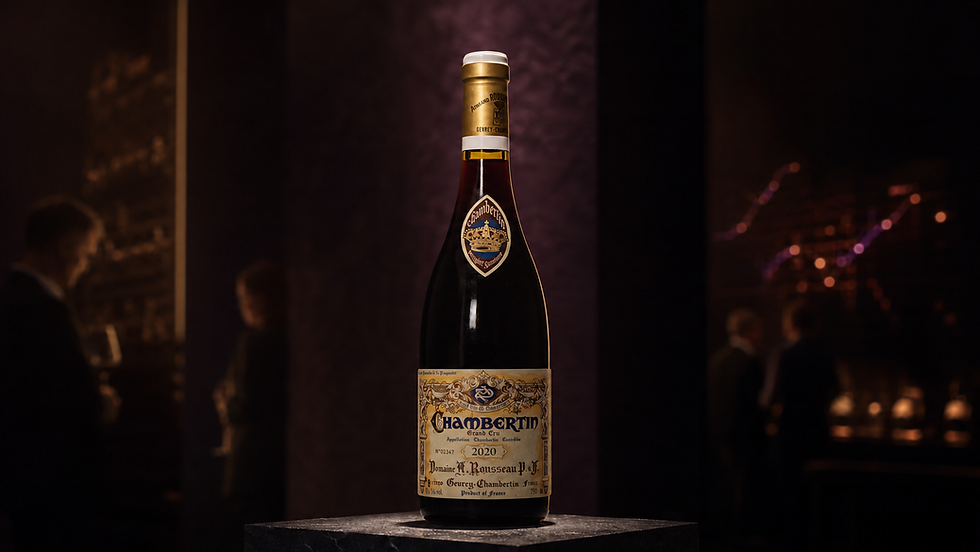
Burgundy carries the most compelling scarcity argument in the market. Grand Cru vineyards are measured in single hectares, not estates. Annual production from the top domaines runs to a few hundred cases. Every bottle consumed permanently contracts supply while global demand keeps growing, and that pressure does not ease during equity market downturns. The 382% fifteen-year return reflects that dynamic, not any speculative premium.
Bordeaux premier cru sits alongside it for a different reason: depth and liquidity. A broader production base means more bottles in circulation, which makes partial exits and rebalancing considerably more practical than with Burgundy. First-growth and second-growth Bordeaux remain the most actively traded investment wines in the world, and the 174% fifteen-year return, while lower, comes with a market that is genuinely navigable.
The third tier, California allocation wines, is available only to investors with access to the mailing list system and is specific to the US market. It is covered in the section below.
A portfolio spread across all three captures the global scarcity story alongside domestic market liquidity. For more detail on position sizing and entry timing, the Lafleur guide to wine investment in the United States sets out the full framework.
The domestic investment tier: Screaming Eagle, Harlan Estate and Dominus
California's cult wine market operates unlike any other fine wine segment in the world. Producers including Screaming Eagle, Harlan Estate, Dominus, Bryant Family and Colgin sell exclusively through private mailing lists, with no retail channel and waitlists that can stretch for years. If you are not on the list, there is no back door.
Secondary market prices reflect that scarcity without ambiguity. Screaming Eagle has returned over 30% annually in strong vintages, according to market data from CultX and Haute Living. The return is consistent because the supply is fixed and shrinking against a collector base that keeps growing, regardless of what equity markets are doing.
For investors based in the United States, this is a genuine structural advantage that does not exist for European or Swiss advisors. A portfolio combining European fine wine with California allocation wines captures a return profile that simply is not available to those working exclusively from outside the US market.
What to look for in a wine investment advisor
The quality of advisory services in this sector varies considerably, and the differences are not always obvious from a website or brochure. A few specific questions get to the substance quickly.
Start with pricing. The standard industry model involves markups of 10-25% on acquisition prices, often undisclosed. An advisor who passes the acquisition price directly to the client and takes a disclosed commission has no financial incentive to favour one wine over another. Ask specifically whether the price quoted is the price paid at source. If the answer is unclear, or hedged, that tells you something.
Ask whether the advisor shares in the upside. Commission structures that include a percentage of net profit mean the advisor does better when the portfolio does better. A flat fee or undisclosed markup means they get paid regardless of outcomes. That difference in structure creates a difference in behaviour over time.
Allocation access is harder to assess but worth probing. Sourcing limited production releases, older vintages from private sellers and wines from restricted distribution requires relationships built through years of direct dealing with negociants, domaines and collectors. It is not a product feature that can be launched. Ask specifically which allocation wines they have access to and how that access was established.
The relationship-led versus platform-based distinction matters at the portfolio construction level. Platforms standardise the service because they have to: the economics only work at scale. A relationship-led advisor builds portfolios around the individual circumstances of each client, including tax domicile, investment horizon, existing holdings and what the client actually wants to own. For a UHNWI investor or family office client, those variables make a material difference to outcomes.
Finally, look at the engagement terms. An advisor who requires a monthly commitment or subscription has a structural incentive to generate activity. A wine investment portfolio built to hold over ten years does not need monthly transactions. The engagement model should reflect the investment logic, not work against it.
For more on structuring a holding from abroad, read How International Investors Structure Fine Wine Holdings and How Much Fine Wine Belongs in a Diversified Portfolio, and see our Fine Wine Investment overview and the Fine Wine Investment Guide for the wider approach.
If you want a private conversation about what a fine wine investment portfolio could look like for your situation as a US-based investor, we are happy to talk.